
Search
Search

 Eng
Eng
 Eng
Eng

Corporate governance and economic governance are closely connected. Until now, analysis of the links between them has tended to focus on the top-down perspective – the idea that better laws and enforcement make better companies – but this article develops a complementary bottom-up perspective. It shows how five transmission pathways – demonstration, finance, market integrity, collective standard-setting and human capital diffusion – can enable firm-level governance reforms to contribute to wider governance outcomes. These bottom-up effects are reliant on enabling conditions such as visible performance signals and supportive external catalysts, especially in transition markets where top-down reform is slow. The approach adopted here is conceptual and informed by practice, offering an analytical framework rather than causal proof. The aim is to provide investors, development finance institutions and reformers with a structured way of thinking about firm-level governance as a lever for broader institutional gains.
Gian Piero Cigna, Head of Financial Law Unit, EBRD (cignag@ebrd.com)
Patrik Stålgren, Head of Cross-Pillar Support on Economic Governance, EBRD (stalgrep@ebrd.com)
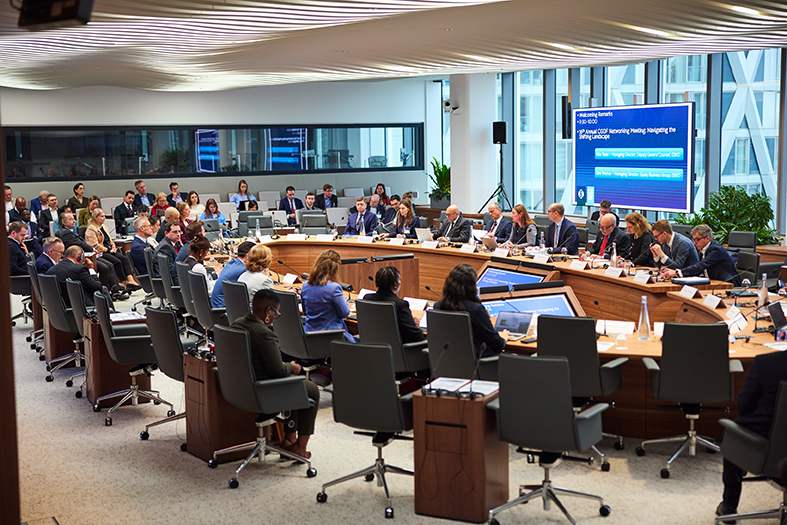
With governance risks multiplying – ranging from geopolitics and cyber-threats to artificial intelligence and sustainability pressures – development finance institutions (DFIs) are under growing pressure to turn governance principles into practical results. This article looks at how the Corporate Governance Development Framework (CGDF), launched by the EBRD and partner DFIs, is evolving from a shared methodology into a more action-oriented platform for cooperation. Drawing on discussions at the 16th Annual CGDF Network Meeting in London, it argues that the framework’s future lies in usable tools, mutual reliance and stronger implementation support that can make governance reforms more visible, coordinated and effective.
Pavle Djurić, Senior Counsel, EBRD (djuricp@ebrd.com)
Bruno Sbardellini Cossi, Corporate Governance Director, IDB Invest (brunosb@iadb.org)

Founder-led family firms often thrive on speed, stakeholder trust and concentration of authority – until scale, business complexity and/or succession challenges turn those strengths into weaknesses. This article looks at the “succession gap” and offers a practical route from founder-centric governance to institutionalised oversight
and control – aligning family governance arrangements with corporate governance requirements, professionalising the board and management, and preserving the business’s mission and long-term direction without the family having to surrender ownership and control.
Anar Aliyev, Principal Counsel, EBRD (aliyean@ebrd.com)
Alberto Atienza Güell, Associate Director, Private Equity, EBRD (guella@ebrd.com)
Leyal E. Savas, Senior Corporate Governance Officer, IFC (lsavas@ifc.org)

This article argues that the digitalisation of trade should be understood not just as a logistics upgrade, but as an economic governance reform. It looks at how digital trade strengthens transparency, accountability and trust across three dimensions: business-to-government processes, business-to-business legal instruments and government-to-government data exchange. Using the Middle Corridor as a case study, the article shows how paper-based systems create avoidable friction, legal uncertainty and border delays. It concludes that legal reform, interoperable public infrastructure and coordinated institutional action are essential in order to build resilient, bankable and trusted trade corridors.
Milot Ahma, Principal Counsel, EBRD (ahmam@ebrd.com)
Christine Hagedorn, Principal Counsellor, Competitiveness and Economic Governance, EBRD
Jamie Macadam, Associate, Corporate Sector Advisory, EBRD

As this article explains, the corporate governance paradigm is no longer about how companies are run internally; it is about how they manage risks – especially those that affect the wider economy. When company failures can harm markets, taxpayers or essential services, their governance becomes a matter of public interest and a core element of economic governance. This article looks at banks, listed companies, state-owned enterprises and strategic sectors, showing that crises have consistently pushed standards higher.
Gian Piero Cigna, Head of Financial Law Unit, EBRD (cignag@ebrd.com)
Liubov Skoryk, Counsel, EBRD (skorykl@ebrd.com)

Global climate finance is increasing at an unprecedented pace, yet much of it is failing to reach the economies that need it most. This article considers the structural constraints on efficient capital allocation in the economies where the EBRD operates, looks at how better governance and transition planning translate into finance by reducing information asymmetry, reviews evidence from labelled bond markets and draws strategic implications for corporates, financial institutions and the Bank itself. By bridging the gap between climate ambition and financial credibility, robust governance frameworks and credible transition plans – including those supported by the EBRD’s Corporate Climate Governance Facility (CCGF) – can unlock investment, reshape risk perceptions and determine where capital ultimately flows.
Hakan Ekim, Counsel, EBRD (ekimh@ebrd.com)
Cem Gündoğan, Principal, Climate Strategy and Delivery, EBRD (gundogac@ebrd.com)

Sustainability disclosure is rapidly shifting from a compliance matter to a core function of economic governance. This article looks at how ISSB standards (IFRS S1 and S2) – alongside emerging regional frameworks such as the EU’s ESRS – are reshaping the ways in which companies assess risk, strategy and value creation. Drawing on the EBRD’s experience, it shows how the Bank actively applies ISSB-aligned approaches across its investments and advisory work to strengthen governance, support decision-making and unlock access to capital. Examples from Türkiye, Central Asia and Africa show how phased, practical implementation can turn disclosure into a driver of resilience, competitiveness and low-carbon transition.
Michael C. Strauss, General Counsel, EBRD (straussm@ebrd.com)
Veronica Bradautanu, Principal Counsel, EBRD (bradautv@ebrd.com)

This article looks at how EBRD investment, technical cooperation and policy engagement can contribute to more transparent, predictable and market-oriented mining frameworks under the Bank’s Economic Governance Strategy 2026-30, with a focus on the Bank’s support for economic governance in that sector through legal, regulatory and institutional reform. Drawing on examples from Mongolia, Tunisia, Ukraine and Uzbekistan, the article highlights the role that law plays in strengthening investor confidence, improving regulatory governance and enhancing public institutions’ capacity to design and implement sector reforms.
Paul Moffatt, Senior Counsel, EBRD (moffattp@ebrd.com)
Chris Tassis, Counsel, EBRD (tassisc@ebrd.com)

This article examines the enactment of Kazakhstan’s New Banking Law in March 2026 – a landmark reform in the modernisation of the country’s financial sector and a critical step in strengthening its investment environment. Drawing on the EBRD’s longstanding engagement in the country and the technical assistance provided to the Kazakh financial regulator, the article analyses the factors driving reform. It explains how the new legal framework introduces a differentiated licensing regime for smaller and universal banks, establishes a modernised bank recovery and resolution framework substantially aligned with international standards, and strengthens certain aspects of corporate governance, as well as regulating digital financial assets through an accompanying Omnibus Law. The article also discusses implementation challenges, the scale of secondary legislation and remaining reform priorities, highlighting the key role of strong legal institutions in supporting financial stability and international investment.
Catherine Bridge Zoller, Senior Counsel, EBRD (bridgec@ebrd.com)
With a contribution from
Srdjan Kokotović, Principal, Capital and Financial Markets Development, EBRD

Increasingly, public procurement is being shaped by trade reciprocity rules and industrial policy objectives, with restrictions on market access fragmenting procurement markets. For transition economies, this can both limit export opportunities and complicate vital projects financed by multilateral development banks (MDBs), where co-financing means that geographical eligibility requirements may apply or projects may be subject to multiple procurement regimes. This article argues that closed or discriminatory procurement markets can increase costs and reduce the quality and affordability of public infrastructure and services, without necessarily delivering the expected industrial benefits. It concludes that MDBs have a critical role to play in both promoting international trade rules for government procurement and keeping transition economies connected to international trade and investment, while improving project outcomes.
Eliza Niewiadomska, Senior Counsel, EBRD (niewiade@ebrd.com)
Morana Vučinić, Senior Counsel, EBRD (vucinicm@ebrd.com)