
Read our Cookie policy here.
Kyrgyz Republic
Major structural reform developments
Banking sector indicators remain stable, partly helped by the relaxation of prudential regulations.
The capital adequacy ratio was 25.6 per cent at 30 June 2020 (compared with 24 per cent in 2019). The liquidity ratio stood at 63 per cent at 30 June 2020 (compared with 64 per cent in 2019). The non-performing loan ratio increased slightly to 8.8 per cent in July 2020 from 7.9 per cent a year ago. Nevertheless, the sector’s capitalization and asset quality are expected to worsen somewhat, reflecting the economic contraction in 2020.
The Kyrgyz Republic has to import electricity in 2020 and early 2021 because of a shortage of water in the Toktogul reservoir.
The country is planning to purchase 1 billion kWh of electricity from Kazakhstan, Tajikistan and Turkmenistan. The cost of imported electricity exceeds revenues from residential tariffs, necessitating cross-subsidization by other sectors. Residential tariffs are to remain unchanged in 2020, thus failing to encourage households to save energy. Consequently, electricity consumption in the Kyrgyz Republic exceeds that of peer countries with similar weather conditions, according to an IMF study. Low tariffs also lead to suboptimal investment in the sector, inefficient use of energy, and financial losses. Energy sector companies’ cumulative debts reached KGS 110 billion as of May 2020 (US$ 1.5 billion, 19 per cent of GDP).
A new legislative framework for public-private partnerships (PPPs) is in place.
The new legislation, which came into effect in August 2020, strengthens the identification, approval, implementation and evaluation process of PPPs in several ways. Under the new rules, the PPP unit is moved to the prime minister’s office, a new ministerial committee will select suitable projects and refer them to cabinet, and another committee will assess contingent liabilities and thereby financial risk to the government. The new legislation also ends the exemption under the previous law of the water and energy sectors, which had hindered sound project selection and risk analysis.
E-government reforms have progressed thanks to steps taken under the digital transformation concept “Sanarip Kyrgyzstan 2019-2023”.
In the UN Global E-Government Development Index for 2020, the Kyrgyz Republic ranked 83rd out of 193 countries, second after Kazakhstan in Central Asia. The country advanced eight notches from last year. In particular, the Kyrgyz Republic posted a 73 per cent improvement in telecommunications infrastructure.
The new Business Ombudsman Institute is operational.
The institute, established to defend the rights, interests and freedoms of entrepreneurs, accepted its first complaints in April 2020 in the midst of the crisis. As of the end of September 2020, 17 investigations had been completed, with five cases resolved with an overall monetary value of around KGS 7 million (US$ 86,000).
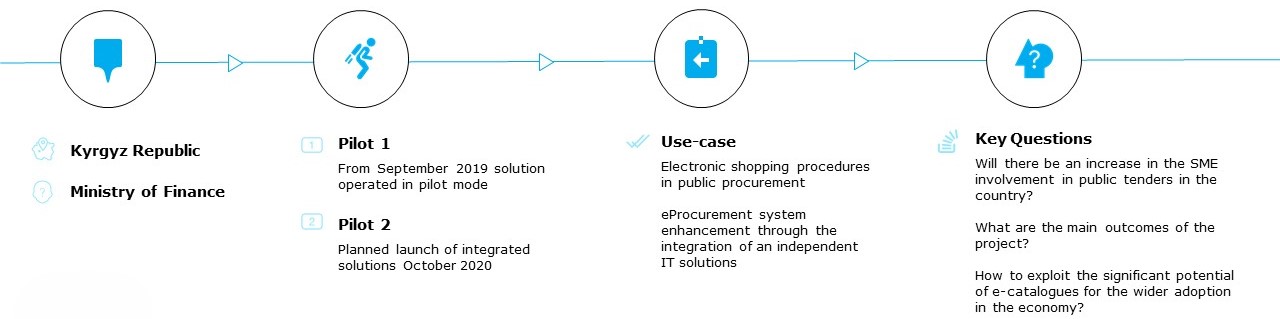
Case study: Supporting development of the e-catalogues by the Public Procurement Authority
Background
- 2014 - Launch of the modern electronic procurement system to conduct procurement processes electronically
- 2019 - Launch of the new e-catalogue in pilot mode as a separately operated solution
- 2019-2020 - Integration of the new e-catalogue with the eProcurement system to facilitate the participation of small and medium enterprises (SMEs) in public tenders conducted electronically on the eProcurement system.
Aim
- Integrate the e-catalogues with the eProcurement system to ensure a single point of access to information on public procurement
- Provide access to the e-catalogues via eProcurement system to enable electronic shopping procedures encouraging the participation of local small business in electronic public procurement tenders
- Ensure Open Contracting Data Standard (OCDS) coverage of procedures conducted in the incorporated e-catalogue to encourage use of the open data on all public procurement procedures which are conducted electronically in the country.
Technology
- Open Source Software was used to produce the e-catalogues
- The integration of the eProcurement system and the prototype of the e-catalogues was performed at the system level, integrating partial data infrastructure components into one public data infrastructure
- The integration carried out in line with the implemented localized OCDS schema to ensure the publication of OCDS data about procedures conducted in the e-catalogues module
- The incorporated e-catalogue functionalities enables Economic Operators to easily register, list their products, goods, and services, and submit proposals online. Contracting Authorities can publish tenders, specify requirements, monitor prices, and search, select, and order products.
Results
- Enhanced competition, transparency and trust due to implemented accessible, simple and easy to use tools for procurement involving SMEs
- Equal opportunities for SMEs to participate in public procurement, and the promotion of SME development with the additional benefit of reduced transaction costs for Contracting Authorities and Economic Operators
- Expected increase in participation of SMEs in public tenders conducted on the Kyrgyz eProcurement system.
Bishkek
Capital
6,457,000
Population
199,900SQ KM
Area
Kyrgyzstani Som
Currency
Highlights
- Real GDP contracted sharply in the first three quarters of 2020. A drop of 6.0 per cent in GDP year-on-year in this period was partly influenced by a 7 per cent year-on-year drop in remittances in the first eight months of 2020, and by strong social distancing measures which had a severe impact on services and construction.
- Bilateral and multilateral creditors have provided support. The Kyrgyz Republic was the first country to receive Covid-19-related emergency financial assistance from the International Monetary Fund (IMF), amounting to a Rapid Credit Facility of US$ 241.8 million, while major bilateral creditor countries have agreed to postpone debt repayments.
- The government responded to the pandemic with a package of economic stimulus measures. An anti-crisis fund, amounting to 2 per cent of GDP in 2020 and 7 per cent of GDP in 2021, was created to provide concessional financing to enterprises in the hardest-hit sectors and encourage digitalization.
Key priorities
- The authorities should continue providing targeted support to vulnerable households and small and medium-sized enterprises (SMEs). This will be particularly vital in the hardest-hit sectors, such as hospitality and construction, with a focus on preserving existing, and creating new, jobs for returning migrants and young workers, including through public work programmes.
- Further efforts are needed to digitalize the economy. Measures should be taken to upgrade internet connectivity, particularly in the regions, and develop digital skills to enable remote learning and working.
- Maintaining macroeconomic stability while exercising fiscal discipline will be important. The government has committed to stabilize public debt at a sustainable level, and the authorities should therefore refrain from non-priority spending in order to bring the fiscal deficit below 3 per cent of GDP in 2021.