Search
Search
Who we are
Overview: about the EBRDWho we are
Overview: about the EBRD
Explore the EBRD’s journey over the decades, investing in businesses, supporting economies and driving lasting change across its regions.
What we do
Overview: how the EBRD operatesWhat we do
Overview: how the EBRD operates
Across three continents, the EBRD supports the transition to successful market economies.
Work with us
Overview: how you can work with the EBRDWork with us
Overview: how you can work with the EBRD
We draw on three decades of regional knowledge and financial expertise to tailor our products and approaches to each client's needs.

 Eng
 Eng
January 2026
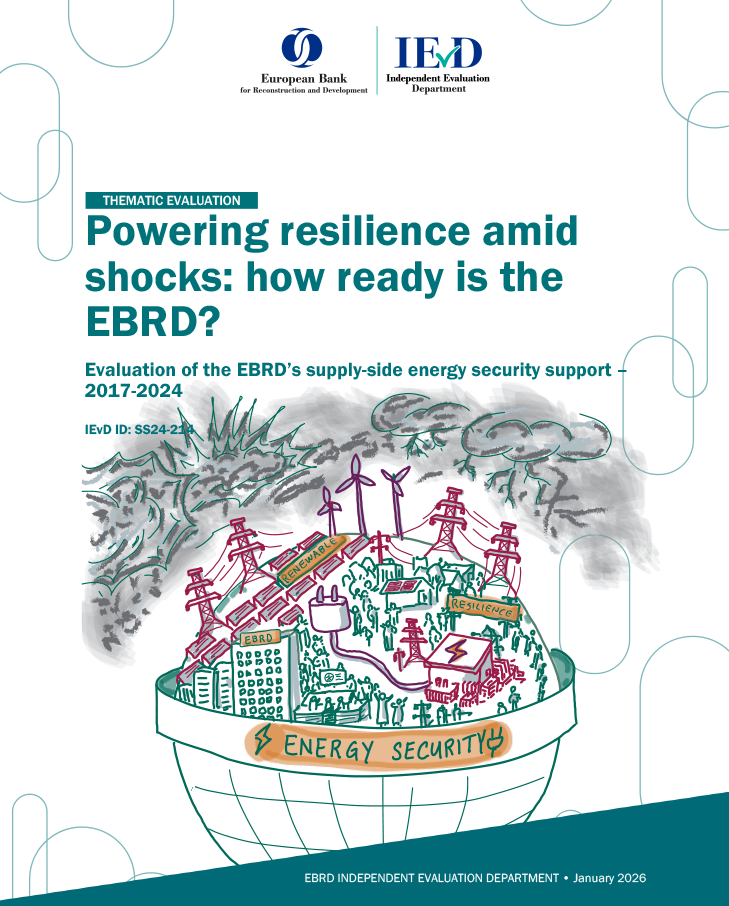
The evaluation covered the “supply-side” of energy activities, including €15.6 billion in ABI's energy supply through 305 investments, as well as policy engagement, during the period 20172024. The “supply-side” of energy activities is defined as the endeavor to ensure a stable, reliable, and sufficient supply of energy through diversified sources, resilient infrastructure, and integrated markets; this encompasses the generation, transmission, and storage of energy, as well as the mitigation of vulnerabilities to exogenous shocks and reliance on energy imports.
The evaluation offers three key findings. First, EBRD demonstrated strong crisis responsiveness, delivering timely, flexible, and context-specific support that helped stabilise energy systems under severe stress. However, its approach to long-term strategic crisis preparedness remains underdeveloped. The lack of clear, actionable steps for implementation in both crisis and non-crisis settings and the absence of a unified definition has resulted in fragmented approaches at the country level. Second, demand-driven interventions strengthened energy security, though rapid liquidity support at times risked creating dependency. While emergencies involved trade-offs with decarbonisation, the Bank continued to support renewable energy in more stable environments, such as Egypt and Albania. Third, decentralised operations enable quick responses, but inefficiencies — like slow disbursement and fragmented data — limited overall impact, highlighting the need for improved tools to measure and communicate energy security and resilience outcomes.