Search
Search
Who we are
Overview: about the EBRDWho we are
Overview: about the EBRD
Explore the EBRD’s journey over the decades, investing in businesses, supporting economies and driving lasting change across its regions.
What we do
Overview: how the EBRD operatesWhat we do
Overview: how the EBRD operates
Across three continents, the EBRD supports the transition to successful market economies.
Work with us
Overview: how you can work with the EBRDWork with us
Overview: how you can work with the EBRD
We draw on three decades of regional knowledge and financial expertise to tailor our products and approaches to each client's needs.

 Eng
 Eng
January 2025
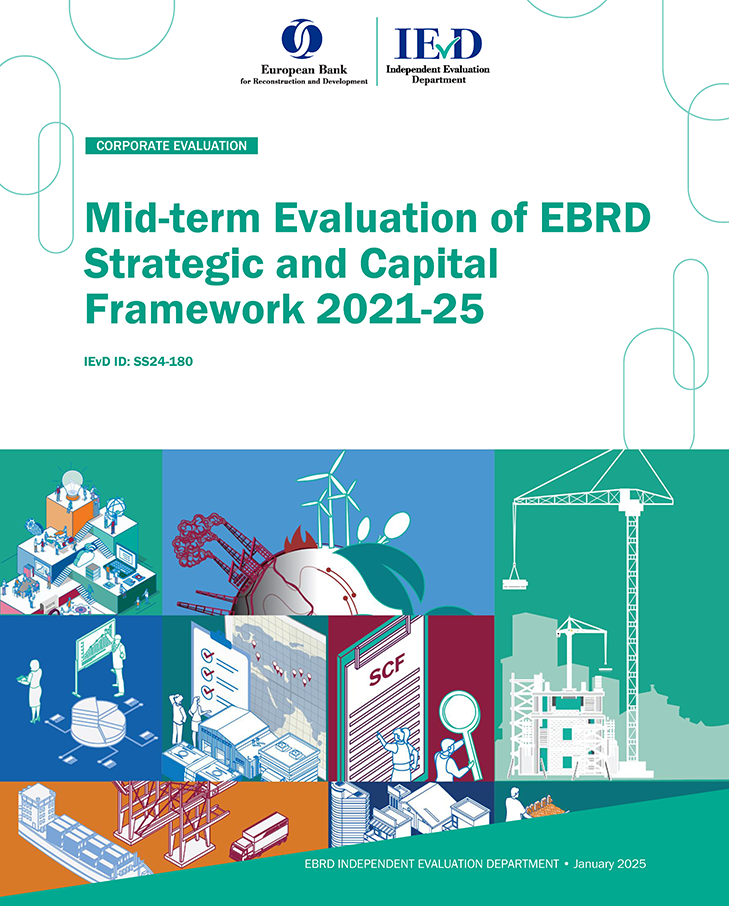
The mid-term evaluation of the Strategic and Capital Framework (SCF) 2021–25 supported the preparation of the SCF 2026–30 by providing evidence-based insights into performance and early results. The evaluation focused on the strategy component of the SCF and covered the period 2021–23. It assessed the extent to which the SCF has been operationalised, the results achieved in key strategic areas, and the effectiveness of efforts to build a learning culture and improve results management.
GET 2.1 has been a transformative success story for EBRD. Despite challenging conditions, the Bank met GET 2.1’s central target: 50% of financing was green every year of the strategy’s implementation, and in 2024, the EBRD went even further, with the GET ratio reaching 58%. The design of GET 2.1 was ambitious but lacked clear, actionable pathways and robust performance metrics to support the shift towards taking a systemic approach. Without a Theory of Change and a performance dashboard which integrated systemic components, implementation of the systemic approach endorsed within GET 2.1 was uneven. There was significant progress in strengthening operationalisation but poor use of data and conflation of GET and transition impact remain ongoing issues. The Green Monitoring, Reporting and Verification system (MRV) is a big step forward but will take time to deliver results. The division between GET and Green ETI remains unclear, and the methodology for green PIM, despite adopting a joint MDB agreed methodology, leads to significant overestimates. From a financing perspective, GET 2.1 has been successful. What is less clear is what that financing means for CO2 emission reductions or systemic change.
Strategy Report
PDF format / 1.48 MBManagement Comments
PDF format / 0.21 MBTechnical Report: Operationalisation
PDF format / 2.55 MBTechnical Report: Crisis Response
PDF format / 1.55 MBTechnical Report: Green Results
PDF format / 1.37 MBTechnical Report: Mobilisation
PDF format / 2.13 MBTechnical Report: Learning and Knowledge Management
PDF format / 1.47 MB