Launch presentation on Youtube
Watch it back on Youtube
Who we are
Overview: about the EBRDWho we are
Overview: about the EBRD
Explore the EBRD’s journey over the decades, investing in businesses, supporting economies and driving lasting change across its regions.
What we do
Overview: how the EBRD operatesWhat we do
Overview: how the EBRD operates
Across three continents, the EBRD supports the transition to successful market economies.
Work with us
Overview: how you can work with the EBRDWork with us
Overview: how you can work with the EBRD
We draw on three decades of regional knowledge and financial expertise to tailor our products and approaches to each client's needs.

 Eng
 Eng
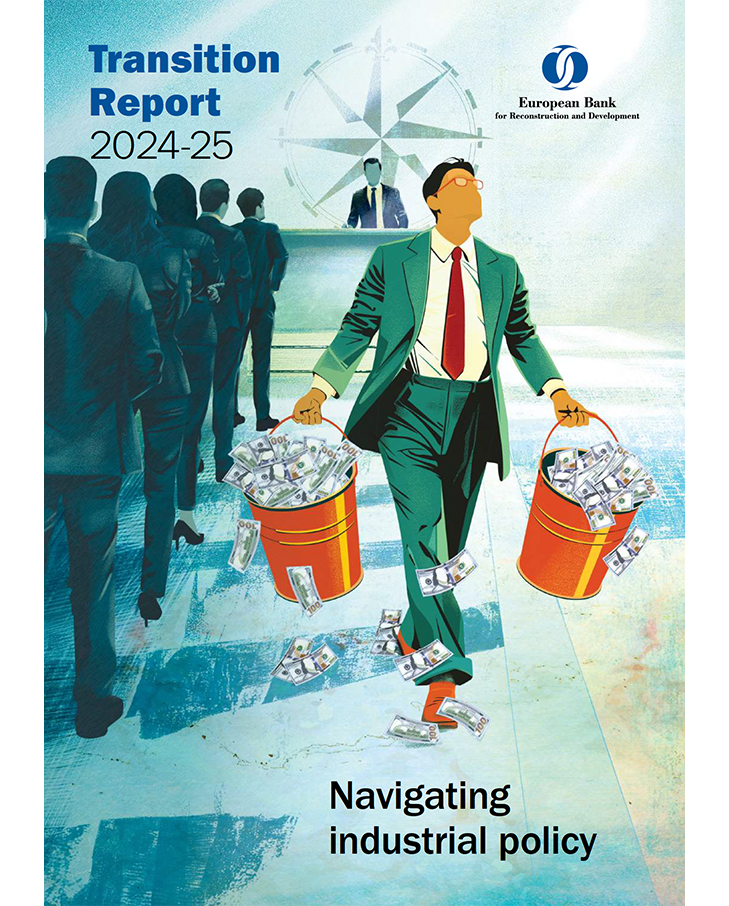
The Transition Report 2024-25 focuses on industrial policies in the EBRD regions and beyond. Such policies have seen a resurgence, seeking to address market failures such as environmental degradation. However, their track record is mixed. Their growing popularity is shaped primarily by domestic political economy considerations and rising geopolitical tensions. While industrial policies are typically employed by higher-income economies, they are also now used more frequently in economies with less administrative and fiscal capacity to implement them.
Publication date: 26 November 2024
ISBN: 978-1-898802-56-3
ISSN: 1356-3424

Foreword
Industrial policies – strategic interventions designed to reshape an economy’s production structure – have experienced a remarkable global resurgence. These policies can be effective and justified when addressing clear and pressing market failures, such as climate change and environmental degradation. However, their overall track record is mixed, particularly when considering their actual benefits, the costs incurred and the consequences of missteps.

Executive summary
This report takes an extensive look at industrial policies in the EBRD regions and beyond. Such policies, which are aimed at changing the sectoral composition of production in an economy, have seen a resurgence in recent years, seeking to address increasingly pressing market failures such as environmental degradation. Their track record is mixed at best, with their growing popularity being shaped primarily by domestic political economy considerations and rising geopolitical tensions.

Chapter 1

Chapter 2

Chapter 3

Chapter 4

Chapter 5