

Event
The EBRD at COP31
COP31 will take place between 9 November and 20 November 2025 in Antalya, Turkiye
20 Nov 2026

 Eng
 Eng
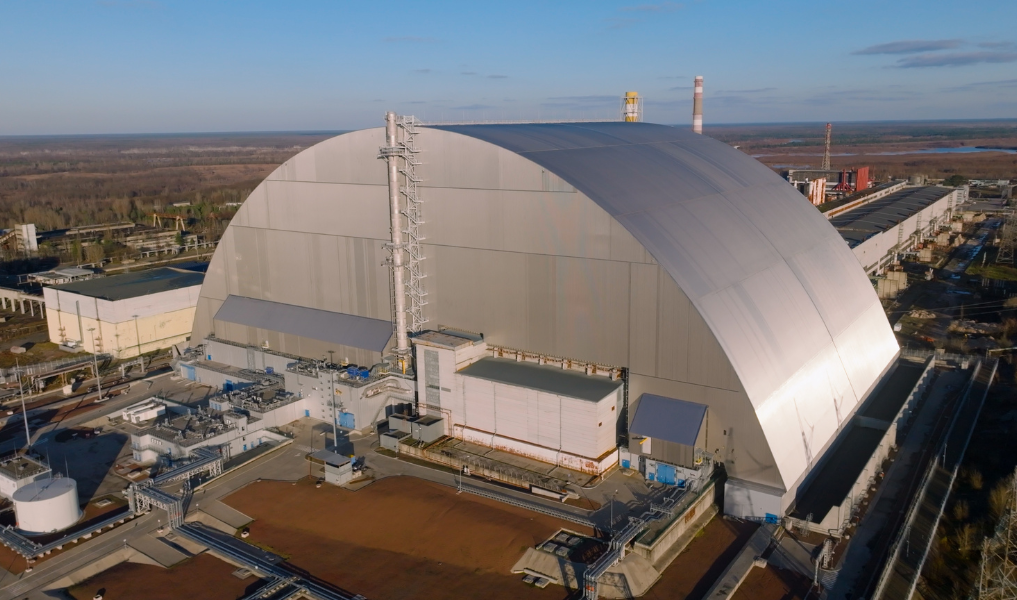
The international community has delivered a strong and united response to the damage caused to the Chornobyl New Safe Confinement (NSC) by a Russian drone on 14 February 2025.
At the High-Level Donor Pledging Conference hosted in Paris by the Government of France, the Government of Ukraine and the European Bank for Reconstruction and Development (EBRD), 14 countries and international organisations pledged to contribute a total of €303 million to the International Chornobyl Cooperation Account (ICCA), managed by the EBRD, to support the restoration works. Further pledges are expected in the coming months.
This issue has been a top priority for French President Emmanuel Macron, as France holds the G7 presidency this year. In June, the leaders of the G7 countries and their key partners agreed to fund, fully secure and safeguard the facilities at Chornobyl. French Economy Minister Roland Lescure led this initiative through the G7 Finance track.
This is a clear demonstration of the international community’s commitment to nuclear safety and its solidarity with Ukraine. While the full scale of the task will only become clear as detailed engineering work progresses – reflecting the uncertainties inherent in Chornobyl, one of the world’s most vulnerable nuclear facilities – the support announced is a major step forward.
Thirty-four countries and international organisations took part in the Conference, in person and online. Significant contributions were announced by the European Union, Canada, Germany, France, the United States of America, the United Kingdom, Norway, Switzerland, Lithuania, Austria, Estonia and others. The Conference also welcomed new donors beyond the G7 and the European Union, broadening the coalition that made the original NSC possible. Greece, Moldova and the Netherlands indicated that they would announce pledges in the coming months.
The NSC is the key protective structure ensuring nuclear safety at Chornobyl. It confines the radioactive remains of Reactor Unit 4 and enables the safe dismantling of the original sarcophagus and the destroyed reactor. The drone strike compromised both of these core functions. The pledges made in Paris aim to advance the work from temporary repairs and early engineering activities towards restoring the NSC’s core functions, before damage to the cladding exposes the steel structure to longer-term corrosion.
The Conference also sent a powerful message of solidarity with Ukraine and underscored the international community’s firm stance against attacks on nuclear facilities. Nearly 20 years of international cooperation with Ukraine and the donor community, led by the EBRD, produced one of the largest and most successful nuclear safety efforts ever undertaken. The international community's response in Paris shows that this partnership endures.
Minister Lescure said: ““As France holds the G7 presidency this year, support to Ukraine has been a top priority. Not only we reaffirm our absolute support to Ukraine, but it is also a matter of security for everyone. These pledges demonstrate that nuclear safety is a shared responsibility and that Europe and its partners stand firmly with
Ukraine. I am proud and looking forward to show international solidarity on this matter. I truly hope we will reach the required amount by Spring 2027.”
Denys Shmyhal, Vice Prime Minister and Minister of Energy of Ukraine, said: “I would like to thank France for hosting the high-level donor conference in Paris dedicated to the restoration of the New Safe Confinement at the Chornobyl Nuclear Power Plant. In February 2025, the confinement was damaged by a Russian drone. Approximately €500 million is needed to restore the facility. Temporary repairs are already under way. We plan to complete all engineering work and fully restore the containment’s functionality by 2030. We are grateful to every country that has already contributed to the restoration. We appreciate the support of the EBRD, which has been helping Ukraine to secure the Chornobyl Nuclear Power Plant for over 30 years. We urge our partners to join the project, as the stable operation of the Chornobyl nuclear power plant is the key to nuclear safety throughout Europe. At the same time, Russia must pay the final bill for the attack on the Chornobyl nuclear power plant. Therefore, we will work with our partners to recover the restoration costs from Russian assets.”
Odile Renaud-Basso, President of the EBRD, said: “The response in Paris is a real success. It builds on two decades of partnership on Chornobyl and gives us the momentum to restore the NSC and keep the site safe for future generations. Working at one of the world’s most vulnerable nuclear facilities means working with uncertainty, and today’s commitment gives us the confidence to move forward. The EBRD will work with Ukraine, the International Atomic Energy Agency and our donors to turn these pledges into action.”
The contributions pledged in Paris complement existing funds in the ICCA to support restoration works and nuclear safety at the site. Work is already under way. Temporary repairs are being carried out, and early engineering and procurement works worth up to €30 million, approved by donors in March 2026, will enable a substantially firmer cost estimate by the end of 2027.
The main restoration works are scheduled to start in early 2028, with completion currently targeted by the end of 2030. The full cost of restoring the NSC’s core functions cannot yet be known. Uncertainty is inherent in a site as complex and vulnerable as Chornobyl: the scope, schedule and cost of the work will be refined as damage is assessed in detail and engineering solutions are developed, and the final requirement will depend on the detailed planning and engineering programme now under way. Today’s pledges are an important and welcome commitment to that programme and a huge step forward in re-establishing the NSC’s core functions. The ICCA will remain open to additional pledges throughout the first half of 2027.
Notes for editors: