- More than €500 million of new EBRD investment and support for Ukraine announced at Ukraine Recovery Conference in Gdańsk
- Commitments bring total EBRD investments in wartime Ukraine to €10.5 billion
- Bank support strengthens resilience across the whole of Ukraine and every sector of the economy
The European Bank for Reconstruction and Development (EBRD) is increasing its contribution to Ukraine’s economic resilience and future reconstruction with a substantial new package of investments and initiatives.
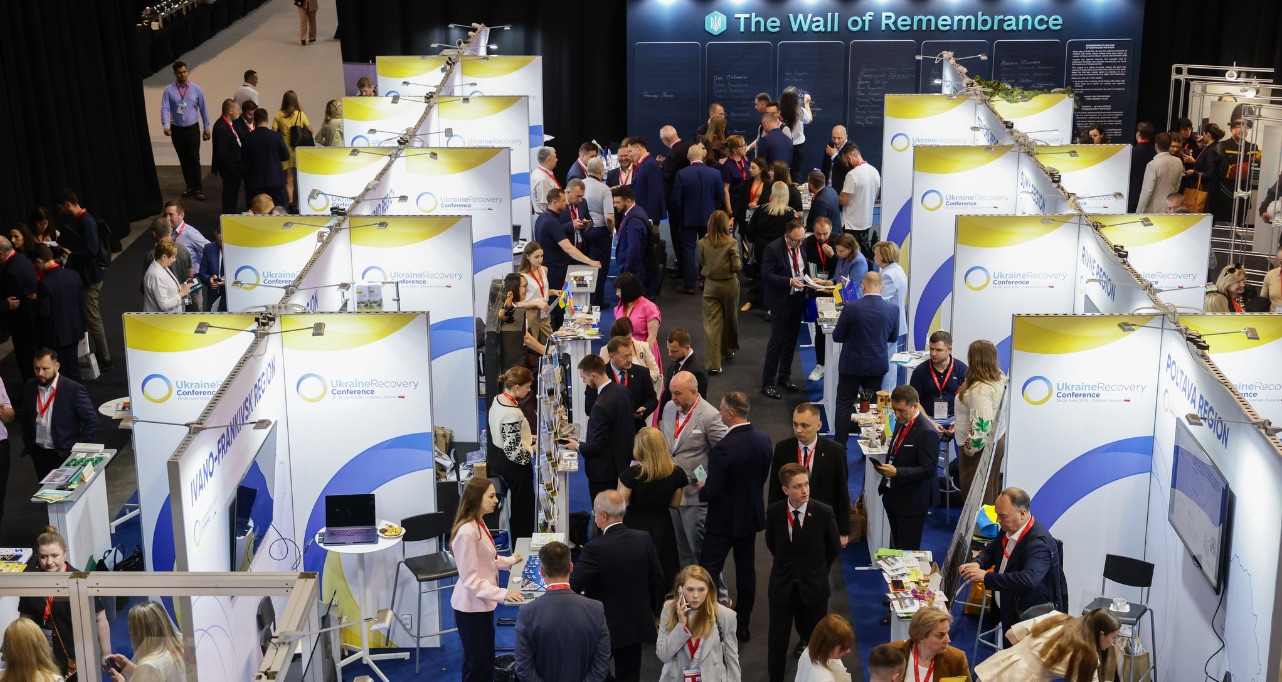
At the Ukraine Recovery Conference (URC) in Gdańsk, Poland, on 25-26 June, the Bank signed a suite of agreements comprising more than €500 million of finance, with several loans also benefiting from donor support, including €100 million from the European Union (EU) through the Ukraine Investment Framework (UIF). This brings total EBRD financing deployed in wartime Ukraine to €10.5 billion.
The EBRD is Ukraine’s largest institutional investor and a key partner to business and government, providing critical support and investments across all sectors of the real economy. This enables the Bank to support lives and livelihoods across the whole country, from Ukraine’s western regions to frontline cities and the Black Sea coast.
At the URC, the Bank announced new targeted investments in Ukraine’s critical sectors.
In the energy sector, the Bank signed new agreements to drive renewable energy generation and support Ukraine’s energy security:
- A €90 million loan to Ukrenergo for the reconstruction of selected substations, in addition to robust support for its corporate governance, including enhancement of compliance and anti-corruption functions at the company.
- A €50 million loan for the development and construction of a 189 MW wind power plant by GNG Group or Galnaftogaz, widely known in Ukraine as OKKO Group. The Bank will provide financing as part of a consortium with the Black Sea Trade and Development Bank, British International Investment (BII), International Finance Corporation (IFC) and Swedfund, and the loan will benefit from a first loss guarantee under the EU’s Ukraine Investment Framework (UIF).
- A common terms agreement with German renewable energy developer Notus Energy for a €65 million loan to be made to finance a 120 MW wind plant. The Bank’s financing would be provided alongside the IFC, the Belgian Investment Company for Developing Countries, and Swedfund, and is expected to benefit from a first loss guarantee from the EU’s UIF. This will be the first transaction under the IFC-EBRD Mutual Reliance Framework.
- A €44.6 million grant to Ukrnafta supported by the governments of Norway and the Netherlands, and pre-financing agreements that consolidate plans to finance new battery storage projects developed by Power One and Kvant Yug.
- The EBRD also signed letters of intent with Germany for a €45 million contribution and Norway for €10 million to the Renewable Acceleration and Market Development for Ukraine Programme (RAMP-UP), a price stabilisation mechanism developed by the EBRD and the World Bank that is designed to unlock private investment in Ukraine’s renewable energy sector. The German and Norwegian funding adds to existing support from the EU, the Netherlands and Switzerland, helping to advance a mechanism that is expected to support 1 GW of new renewable capacity and potentially mobilise €1.5 billion in investment.
At the same time, the EBRD is working through the financial sector to ensure that critical finance reaches businesses across the country.
The Bank signed transactions worth €303 million of EBRD finance with eight Ukrainian banks, enabling a total of €845 million of new credit to Ukrainian borrowers:
- A portfolio risk-sharing (PRS) facility with PrivatBank will enable €265 million of new lending, focusing on supporting micro, small and medium-sized enterprises (MSMEs) and mid-size corporates, with up to 17 per cent of subloans dedicated to long-term capital expenditure (capex) investments under the EU4Business-EBRD Credit Line, helping Ukrainian small and medium-sized enterprises (SMEs) align with EU standards and adopt sustainable, green technologies.
- A PRS facility with Oschadbank will enable €150 million of new lending, focusing on supporting MSMEs and mid-size corporates, with up to 13 per cent of subloans dedicated to long-term capex investments under the EU4Business-EBRD Credit Line.
- With Bank Lviv, the EBRD is enabling €50 million of new lending through a PRS facility, alongside a €10 million local-currency tranche within a €40 million senior loan agreement. The local‑currency loan will benefit from partial risk cover from UK development finance institution BII, aligning with the EBRD’s commitment to mobilise partner and donor support for Ukraine. The PRS facility will support MSMEs, with up to 25 per cent of subloans allocated to long-term investments under the EU4Business-EBRD Credit Line.
- Two PRS facilities with Kredobank will enable €70 million of new financing for Ukrainian mid-sized businesses and SMEs, with close to 13 per cent of subloans dedicated to long-term capex investments under the EU4Business-EBRD Credit Line.
- A PRS facility with UKRSIBBANK will enable €52 million of new lending and focus on supporting MSMEs, with up to 20 per cent of subloans allocated to long-term investments under the EU4Business-EBRD Credit Line, helping SMEs transition to EU standards and adopt sustainable, green technologies. Up to 4 per cent of the risk-shared subloans will go to residential households under the Energy Security Support Facility for decentralised energy generation, storage and energy efficiency measures, all of which are critical for Ukraine’s energy security.
- A committed tranche under a PRS facility with Ukrgasbank will enable €148 million of new financing, primarily supporting MSMEs, with up to 20 per cent of subloans allocated to long-term capex investments under the EU4Business-EBRD Credit Line.
- A committed tranche under a PRS facility with Ukreximbank will enable €50 million of new financing, primarily supporting MSMEs, with up to 20 per cent of subloans allocated to long-term capex investments under the EU4Business-EBRD Credit Line.
- A committed tranche under a PRS facility with Raiffeisen Bank Ukraine (RBU) will support €50 million of new lending, with up to 20 per cent of subloans dedicated to long-term capex investments under the EU4Business-EBRD Credit Line.
These transactions are part of the EBRD's wider projects with Ukraine's financial sector that are expected to mobilise up to €2.2 billion of financing for Ukrainian borrowers.
They benefit from donor support from the EU (€65 million), Sweden (€10.8 million), France (€7.1 million), the Netherlands (€400,000) and other donors to the EBRD Crisis Response Special Fund (€13 million), as well as from Switzerland (€300,000) through the EBRD Small Business Impact Fund, which supports the delivery of non-financial services for banks’ SME sub-borrowers.
Several of these PRS transactions will be eligible for the Bank’s innovative Enterprise Security Enhancement mechanism supported by donor funds, under which Ukrainian banks will be able to offer partial debt relief to borrowers whose assets financed under EBRD-supported lending have been directly damaged by the war.
To further incentivise private investments, the EBRD is working on making war risk coverage more affordable. Thanks to a €5 million EU grant, the Bank will be able to subsidise premiums on insurance covering assets financed by EBRD-enabled subloans, helping MSMEs to protect their investments in Ukraine.
The Bank is also partnering with RBU on a project-by-project risk-sharing programme to provide long-term financing to SMEs and midcaps for more complex investment projects, including those affected by wartime uncertainty. Enabled thanks to first-loss risk cover from the EU under UIF as part of the Ukraine SME Recovery Programme, the first project is RBU’s UAH 350 million (€6.8 million) loan to poultry producer Pan Kurchak, as part of a €20 million investment project to rebuild and modernise its destroyed production facility in the Volodymyr region.
The EBRD is actively supporting cities and communities across Ukraine, including frontline and regional municipalities, in maintaining essential services during the war.
This week, the Bank signed a total of €100 million in new commitments with local municipalities, comprising:
- A €15 million loan to the city of Kharkiv to finance new distributed and resilient heat- and electricity-generating assets. These will help to restore the heat supply to residential, public and other buildings, following critical damage to the city's largest combined heat and power plant as a result of Russian attacks. The Bank’s loan benefits from a first loss guarantee from the EU’s UIF and is complemented by a €17 million UIF investment grant.
- A €12 million loan to the city of Rivne to finance renewable energy and energy-saving measures in 24 public buildings, directly benefiting close to 160,000 people. The Bank’s loan is complemented by a €6 million investment grant from Eastern Europe Energy Efficiency and Environment Partnership and benefits from donor support from Spain and Sweden.
- Emergency liquidity loans to the frontline cities of Dnipro (€25 million), Kharkiv (€15 million) and Kryvyi Rih (€12 million) to help them mitigate the effects of the war on their financial position and ensure uninterrupted provision of essential municipal services. The loans to Dnipro and Kharkiv benefit from a first loss EU guarantee through the UIF, while the loan to Kryvyi Rih is supported by a guarantee from Spain.
- A pre-financing agreement to provide €50 million in emergency liquidity to the city of Kyiv.
Beyond investments, the EBRD continues to deliver important policy support to Ukraine that will be critical for the country’s transformation and accession to the EU. New policy initiatives signed at URC will help to build stronger regulatory frameworks and governance frameworks:
- A memorandum of understanding (MoU) signed with the Ukrainian Ministry of Economy and World Bank Group targets an acceleration in the reform of state-owned enterprises, to strengthen their governance and operations.
- An MoU with the National Bank of Ukraine aims to strengthen sound governance and supervisory effectiveness across the financial sector.
- A statement of comprehensive cooperation with Naftogaz to broaden collaboration on ensuring Ukraine’s energy security and supporting the recovery and modernisation of energy infrastructure.
- An MoU with the Ukrainian Ministry of Culture to cooperate on the development and implementation of public-private partnership projects in the fields of culture and cultural heritage in Ukraine.
- To streamline Ukraine’s reconstruction priorities, the Bank is supporting the State Agency for Restoration and Infrastructure Development in developing a shortlist of priority national road investments to be taken forward through project preparation and financing. These will be integrated into Ukraine's Single Project Pipeline.
- To support sea transport and grain export routes, the Bank will begin work on developing and modernising infrastructure at the Reni and Izmail seaports.
- To ensure Ukraine’s energy sector is resilient, the Bank will support investments and urgent reforms in the sector as part of Team Europe and alongside key international partners. At the URC, the Bank issued a joint paper with the European Investment Bank and the Energy Community Secretariat, reaffirming their commitment to coordinated reform support and co-investment opportunities to enhance resilience and facilitate the alignment of Ukraine’s energy system with EU norms.




 Eng
Eng