
Search
Search

 Eng
Eng
 Eng
Eng
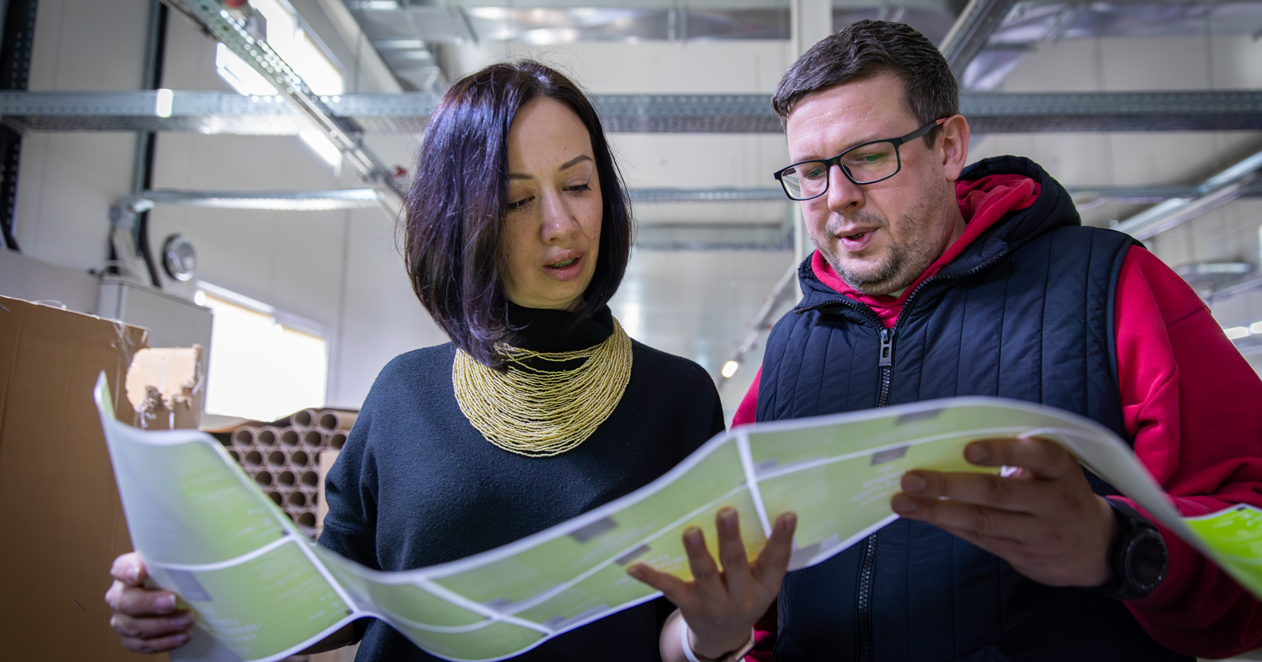
When Russia's full-scale Invasion forced Albina Kudryavtseva to leave her hometown, Kharkiv, she did not just relocate her business, she rebuilt it from scratch in three weeks, keeping every single client and growing her team from 20 to 90 people. With advisory, relocation and financial support from the European Bank for Reconstruction and Development (EBRD), the European Union (EU), Sweden and the United States of America, ALDA (formerly TechnoDruk) has transformed from a spontaneous start-up into a systematic, resilient company ready for European markets.
ALDA's story begins not with a business plan, but with Impending motherhood. Albina Kudryavtseva was working as a commercial director in a printing house when she became pregnant and decided to leave to start her own business.
"I also realised at that time that if I wanted to deliver the quality and service that clients deserved, I had to control every process myself," she recalls. "Another big question I started to ask myself was, what is It all for?"
A heavily pregnant Albina, together with two other women, travelled back and forth to the Unipro region, renting accommodation near the printing equipment she had leased from a friend. The company grew quickly. Within two years, the team had decided to invest in Its own production site in the Kharkiv region, despite having limited savings and almost no access to financing.
What began as a small operation soon evolved into a business focused on premlum, technically complex labels. The company continued to expand, driven by deep Industry expertise, customer trust and an uncompromising focus on quality.
As demand Increased, Albina realised that the company needed stronger Internal structures to support long-term development.
In 2020, ALDA Jolned a consulting project supported by the EBRD and Sweden, which helped the company Introduce key performance indicator (KPI) systems, budgeting, cash-flow management and operational planning. The project also included staff training, process automation and strategic development planning.
"Operational work can be really tough," Albina says. "You can run at a sprint, but give up on the marathon. This support helped us to build a foundation. We became
predictable. That was the most Important result."
Those preparations became critical two years later.
By December 2021, Albina was already convinced that a full-scale war was coming and had started to search for relocation options. Only a few people around her belleved it would happen.
When the Russian Invasion began In February 2022, the company's hometown in the Kharkiv region was occupled almost Immediately. Production stopped as everyone focused on survival and evacuation.
"At first, my brain could think only about the safety of my children," she says. "Only after that I could think about the business."
The company eventually chose Uzhhorod in western Ukraine as Its new base because of its relative safety. The relocation was conducted by part of her team in a very dangerous environment. It happened under constant shelling, with equipment loaded onto trucks whlle explosions could be seen nearby.
"People told me relocation would take at least two months," Albina says. "I sald no, we will restart in three weeks." That Is exactly what happened.
Albina personally reviewed accommodation for employees, met them at the train station and helped familles settle into their new lives.
With support from the EBRD under the Small Business Impact Fund (donors: Ireland, Italy, Japan, South Korea, Luxembourg, Norway, Sweden, Switzerland, Talpel China, the United Kingdom and the United States), they later received a relocation grant that helped the company restore operations and continue serving clients.
"We didn't lose a single customer," she says. "For us, remaining operational meant survival."
The war brought new challenges almost immedlately. Repeated blackouts threatened production, forcing the company to Invest in generators as a matter of urgency to avold losing clients and damaging sensitive equipment.
With support from the EBRD and the EU, as well as a loan from a local bank, ALDA was able to invest in advanced digital printing technologles - an area Albina belleves represents the future of the global label industry. The long-awaited equipment has already been set up and the company can print labels in just a few hours.
Now ALDA Is looking beyond Ukraine. The company has small test contracts In Spain and Lithuanla, and exhibited for the first time at a trade fair in Düsseldorf, Germany.
"The exhibition showed us that European companies are ready to work with us," Albina says. "But we have to prepare. We have already sent a request for another advisory project to help us expand our markets and build our sales function."
For Albina, success is measured not only by contracts or production volumes.
Today, 10 years after founding the company and seven years after launching the firm's own production facility, she says her biggest motivation is still connected to the same question she asked herself in the very beginning: what Is all this hard work really for?
"Success Is first and foremost about the team," Albina says. "It is about people who want to grow alongside me, who genulnely enjoy what we are bullding together, who keep learning every day and care about the firm as much as I do. Only with a team like that can we create the value for clients that this business was founded to deliver.
"My dream is to double in size and then build housing for our people and their familles.
Somewhere they can feel safe enough to rebulld their llves after displacement and war. We have given them the first element of safety - a secure region. Now I want them to have a place they can truly call home. That is what makes It all worthwhile."