Search
Search
Who we are
Overview: about the EBRDWho we are
Overview: about the EBRD
Learn about the EBRD's journey to investing more than €220 billion in over 7,800 projects.
What we do
Overview: how the EBRD operatesWhat we do
Overview: how the EBRD operates
Across three continents, the EBRD supports the transition to successful market economies.
Work with us
Overview: how you can work with the EBRDWork with us
Overview: how you can work with the EBRD
We draw on three decades of regional knowledge and financial expertise to tailor our products and approaches to each client's needs.

 Eng
Eng
 Eng
Eng
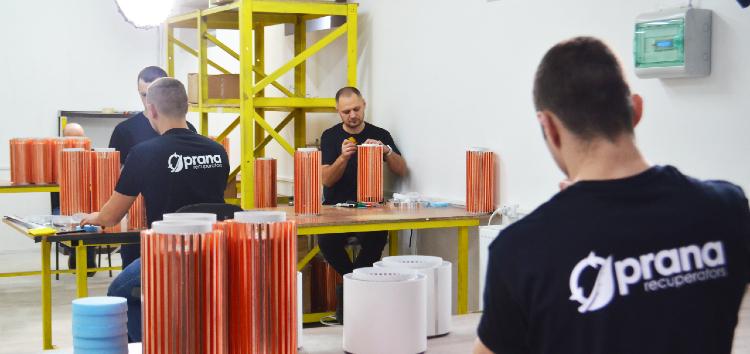
Prana’s ventilation systems create a comfortable indoor microclimate and provide access to fresh air 24 hours a day. Innovative technologies provide quality air not only for people, but also for animals and plants. Prana recuperators are not only popular with kindergartens, schools, offices and medical institutions, but also agricultural companies, which use ventilation systems in greenhouses and farms. During the war, Prana’s ventilation systems have also helped save lives, as they are used in bomb shelters and basements.
Roman Kuzych and Dmytro Krotov, co-owners of Prana, say that the business was created by chance.
“Buildings can also get sick, for example when moulds and fungi grow, making them unsafe to be in. The problem arises when ventilation is inadequate, ineffective or even non-existent. Smart ventilation systems were expensive, huge and required room. Only large premises, usually technical complexes or office spaces, could afford them. This formed our business idea – how to offer a more affordable solution, based first and foremost on consumer needs,” Dmytro says.
Both partners tried out all the products themselves – first samples, then prototypes – in their own homes, before developing them further.
Only 10 years ago, in Ukraine the European market was perceived as difficult to break into.
“We actively took part in international exhibitions, talked to our partners and other businesspeople abroad. They were very surprised that we did everything ourselves, while in Europe they usually work with international programmes, donors, governmental support and so on. We started to investigate and found information on support for small and medium-sized enterprises from the European Bank for Reconstruction and Development and the European Union,” Roman recalls.
“Quality air has always been our priority, so we strived to make the system work accordingly,” Roman says. “If there are impurities in the air, the system responds appropriately, ensuring the comfort and safety of consumers. We also developed a convenient mobile application to manage the system.”
Immediately after the project, Prana received the prestigious Gold Medal (Zloty Medal) award for their development at one of the largest exhibitions in Europe, BUDMA in Poland, in the category of Best Ventilation Product with an important contribution to carbon footprint reduction.
In the first weeks of war, Prana’s production and sales came to a halt. However, the company's management realised that business needed to resume, so that it could continue to pay salaries and taxes to support the country. The company also had obligations towards its international partners. Gradually, Prana started to solve logistical problems and within a month production recommenced.
“It was really emotional – when we started to send trucks abroad with our goods, our partners always returned them full of humanitarian support,” Roman recalls. “We were also looking into how our products could be used to cope with the realities of war, namely in bomb shelters, basements, kindergartens and so on. It turned out that our products were extremely popular and helpful for different purposes and premises.”
In the future, Prana is considering expanding its production. The goal is to have assembly lines in EU countries and open a modern climate laboratory outside of Ukraine. The company’s journey continues: it is now actively working with the EBRD on taking advantage of export opportunities, which is of utmost importance during the war.