
Read our Cookie policy here.
Search
Search

 Eng
Eng
 Eng
Eng
Following the ‘marble troubles’ you may recall from a previous episode, the Bank went through a difficult spring and summer until the arrival of its new President, Jacques de Larosière, in the fall of 1993. He began his presidency with a surgical speech to the staff in the auditorium. He had clearly done some detailed homework by saying in his address that the Bank had several serious issues to confront beyond its marble. These included the lack of a clear strategy, an out-of-control budget and therefore a damaged public image. He then mentioned that he had heard the public and private sector departments of the Bank competed with each other, proposing different products to the same clients in different meetings. This had to end and he gave two weeks for this issue to be solved. Quite a start!
On the strategy question, he set a ‘high energy’ Task Force lead by Nick Stern, the newly-appointed chief economist for the Bank (being part of it is a highlight of my EBRD years). On the budget question, we entered a period of serious stringency with no budget growth for a number of years. And on the image question, the Bank adopted a low profile and became very discreet about its accomplishments.
Once strategic directions were set and approved by the Board of Governors, it was time to think about moving forward in a dynamic manner. The activity of the Bank was increasing rapidly with:
The number of projects signed rising from 3 in 1991, to 34 in 1992 and 147 by 1995.
Our famous ABI rising from €0.1 billion in 1991 to €0.8 billion in 1992 reaching €2.0 billion by 1995.
Annual disbursements exceeded €1.0 billion for the first time in 1995.
It is interesting to note that in the single month of June this year, we signed 50 projects with an ABI of €1.5 billion. And in July 2020 alone, we disbursed €1.0 billion.
This increase in activity lead to the Bank having to start thinking about a capital increase to be able to grow within its capital parameters. This was very far from an obvious proposition, as the case had to be made about the opportunity ahead and about the capacity of the Bank to use the additional capital wisely in the aftermath of the ‘marble troubles’ which had dented our fledgling organisational brand. With determination, the Bank developed the case under the overall leadership of the President including the definition of the initial transition theory of change and methodology by Nick Stern. This also introduced the famous G word, Graduation! These were still optimistic times with the transition process perceived as a quick linear process. My role focused on deriving operational projections reflecting increased support to our countries of operations. This medium term planning process led to the first Capital Resources Review for the period 1996 to 2000. A motivating contribution to place the Bank on a higher orbit of activity.
Anecdotally, I remember that the President used to travel in economy class, including on trans-Atlantic flights to the US. This fact was taken up in the press and reflected positively in the consideration of the capital increase in the US, showing how lean the Bank had become. And I remember that it is in fact in Washington DC, that the news that shareholders were going to support the capital increase reached President de Larosière between two meetings. A real feat to achieve this result within a couple of years of a major crisis.
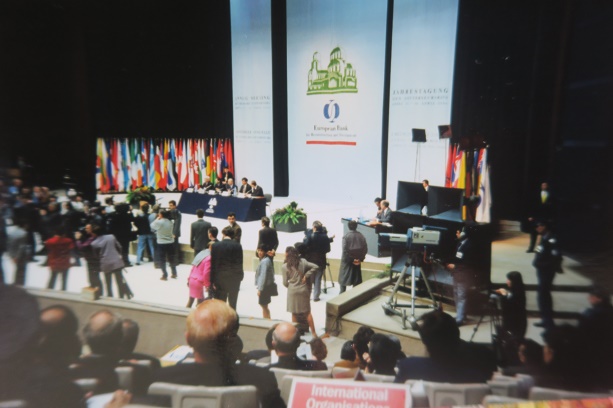
And so we could all go to the Annual Meeting in Sofia in 1996 with the knowledge that the Bank could go forward with the doubling of its capital to 20 billion ECU (the European Currency Unit which preceded the Euro) expanding its range and level of activity with the unanimous support of its shareholders. Way to go!
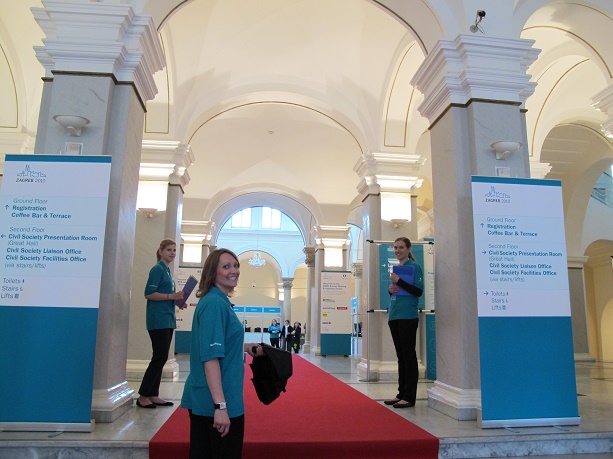
The 2010 Annual Meeting in Zagreb considered and approved the second capital increase of the Bank. The background leading to it was entirely different from the first. Together with the collapse of Lehman Brothers in September 2008, financial markets globally went into a downward spiral. Our countries of operations were hit directly, with the Prime Minister of a single country sending a letter to the Bank requesting a support package of €3 billion. Confronted with this rapidly deteriorating situation, and with President Mirow just starting his mandate, the Bank worked day and night to formulate a crisis response package, very much in the spirit and with the speed of our response to the pandemic this year (one major difference was that we were still in the office together).
This lead to a massive increase in the level of activity with ABI rising from €5.1 billion in 2008 to €7.9 billion in 2009 and €9.0 billion by 2010. Demand for the Bank’s financing was very strong. The big question raised by management to shareholders was simple. The Bank could simply not maintain the increased level of finance to support its countries of operations and clients over the medium term without a capital increase: either the Bank would have to curtail its financing back to pre-crisis levels or a capital increase was required. President Mirow argued clearly for a capital increase of €10 billion. The response from shareholders posed a quandary: while there was strong political support to sustain a high level of annual investment, shareholders requested that a solution be found which would not put further pressure on national treasuries. I remember coming back to my office that afternoon wondering how such circle could be squared. The answer to this challenge appeared to be less than obvious.
After some dynamic thinking, a proposal reflecting the EBRD spirit of innovation and creativity was formulated. Without getting into technical details which could make you doze off, the proposal included a transfer from our cumulated profits into paid-in capital and the introduction of the innovative concept of temporary callable capital. On the back of this ingenious solution, the Board of Governors unanimously approved the second capital increase. This allowed the Bank to sustain activity at or over €9.0 billion ever since. And it continues to provide the capital base for the new Strategic Capital Framework 2021-2025 submitted for approval at the Annual Meeting later that week.
Josué Tanaka | Visiting Senior Fellow at the Overseas Development Institute
Former EBRD Managing Director, Energy Efficiency and Climate Change, Operational Strategy and Planning
Select an image to expand

Select an image to expand