
Read our Cookie policy here.
Search
Search

 Eng
Eng
 Eng
Eng
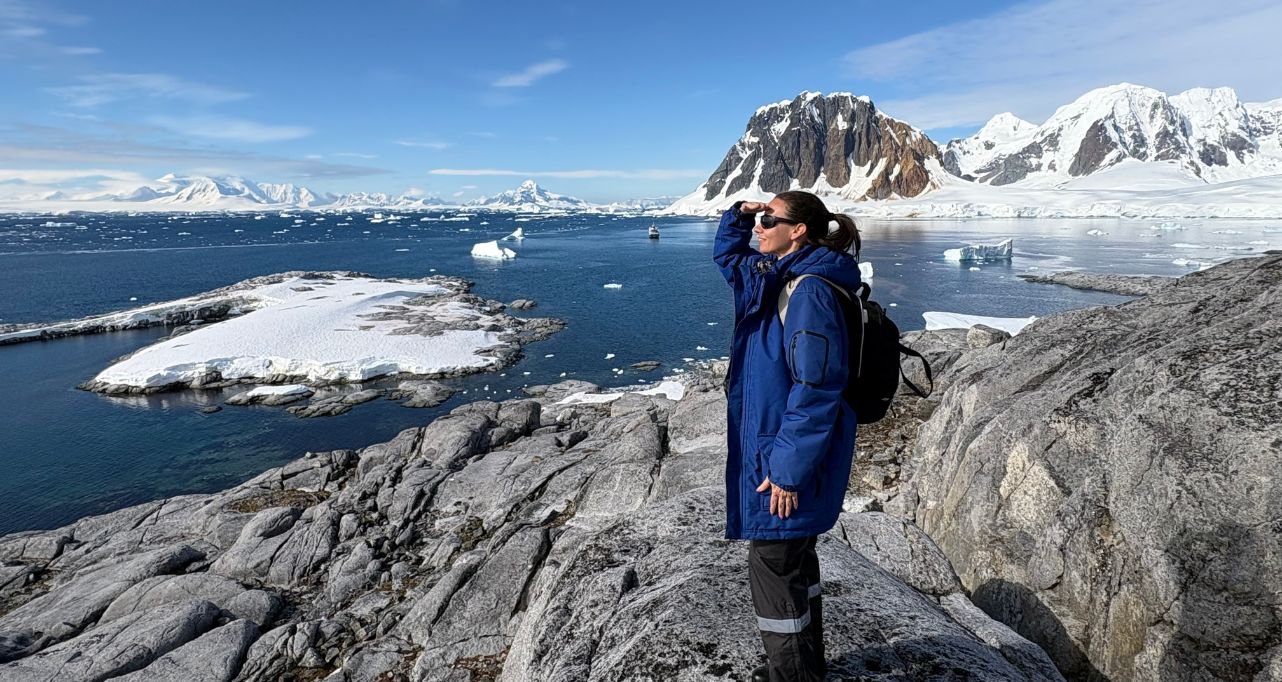
On 1 February this year, I embarked on a discovery and learning voyage to Antarctica with Oceanwide Expeditions. The journey was inspired by my Mom’s spirit and a little bit of personal curiosity, and turned into a beyond-words experience. Who knew Antarctica had so much to offer in terms of unique landscapes, astonishing wildlife and captivating history?
My journey on M/V Ortelius started in Ushuaia, the Argentinian city dubbed “the end of the world” because of its southerly location. Our first adventure was supposed to be the infamous Drake Passage, but luckily, we had remarkably calm conditions for this usually turbulent stretch of the ocean. Two days later, we reached the Antarctic Peninsula through the picturesque Lemaire Channel. Our expedition area was on the west side of the Antarctic Peninsula, with a southernmost position next to Vernadsky Station, at 65°14.45’S/064°15.2’W.
We explored the region on daily Zodiac boat cruises with shore landings. We had to adhere to strict biosecurity protocols, designed to safeguard Antarctica’s untouched environment and preserve its fragile ecosystems. Every item – clothing, boots and gear – was checked meticulously to eliminate all possible contaminants. Ashore, we could not sit, kneel or leave any trace. The other important rule was to keep our distance from the wildlife and always yield to it – though the penguins, often curious and endearingly bewildered, did not seem to follow the same guidelines when it came to us.The whole journey was full of impressions and emotions, but three specific moments stood out for me. Our very first Zodiac cruise happened in perfect conditions – blue sky, sunshine and calm waters. We navigated through an “iceberg graveyard” and admired naturally sculpted icebergs of all shapes and sizes, with intricate patterns on their surfaces. This was the moment it struck me where I truly was, and I can still recall the physical feeling of humility in the face of such majestic nature. That day I also learned that the smell of penguin guano is no joke!
Another Zodiac cruise that will stay forever in my mind happened amid grey fog, snowfall and a biting chill. The uninviting weather offered us something rare and precious, however – complete, pristine silence. With that came the experience of hearing whales breathing around us. As exciting as it was to see whales breaching and swimming, experiencing them through their sounds was even more enchanting. Because of the surreal landscapes and the emotions that abounded, I think everyone’s Instagram posts on the day were set to the music of Interstellar.
And when in Rome … – or rather, Antarctica – why not go all the way, as it were?
In a carefully chosen spot without wildlife, we were allowed to break from the biosecurity restrictions and … go for a swim! I plunged into the icy 1°C waters, a personal feat, and proved that the boundaries of personal comfort can be quite flexible in the right setting.
Beyond the beauty and adventure we experienced, this journey deepened my understanding of our planet’s fragile ecosystems. Antarctica is often described as the last great wilderness, but it is also on the frontline of climate change. The ice may feel eternal, but the continent is warming at a pace faster than the global average. Its glaciers are retreating, with profound (and non-linear) consequences for the rest of the planet – from rising sea levels to shifting weather systems.
The Antarctic ecosystem is not only under climate strain, but also starting to experience pollution. Scientists have confirmed the presence of microplastics in surface waters, in deep-sea sediments and in the snowfall. We also see it in the regurgitated food of penguins and seabirds. While some of this pollution can be traced back to local research stations and tourist vessels, most of it originates from elsewhere: waste from industrial processes, mismanagement of resources and consumer behaviour taking place far away, unconfined by geography.
With this in mind, if I had to choose one word to sum up this extraordinary journey, it would be “interconnectedness”. Our collective actions, or inactions, leave a trace, and it is up to us to define what that trace will be. As “EBRDers”, both current and former, our field of work gives us the opportunity to help create infrastructure, products and communities that benefit both people and the planet, with minimal adverse impact. Antarctica is not “somewhere else”, it is a mirror of everything we do.
Ana Bachurova
Energy Efficiency Lead at the United Nations Environment Programme Finance Initiative | Former EBRD Associate, Climate Strategy and Delivery, Belgrade