
Read our Cookie policy here.
Search
Search

 Eng
Eng
 Eng
Eng
The Baltic states’ energy transition is being driven by two reinforcing aims: to decarbonise in line with European Union (EU) climate objectives and to strengthen energy security following decades of structural vulnerability that was intensified by Russia’s invasion of Ukraine in 2022.
Although Estonia, Latvia and Lithuania have made substantial progress on expanding renewable generation, grid capacity and system flexibility, constraints have become increasingly binding on further low-carbon electricity growth. Renewable deployments are outpacing investments in enabling infrastructure, creating grid-connection bottlenecks and highlighting the need for transmission, distribution and storage investment. These constraints are among the main obstacles to scaling up low-carbon electricity, alongside permitting, market design and revenue capacity, rather than just a shortage of capital or project sponsors.
Infrastructure limitations were further exposed by Europe's 2022 energy crisis, which caused rapid electricity price shocks due to constrained interconnections between the three countries, insufficient balancing capacity and insubstantial storage. While the Baltic states have since completed synchronisation with the continental European grid, reducing their operational dependence on the Russian-controlled electricity system, their grid resilience remains somewhat exposed to physical and cybersecurity risks, given their reliance on a small number of critical cross-border and subsea interconnectors.
The EBRD’s activities are addressing physical system constraints and financial market failures in the Baltic states. They are delivering enhanced renewable energy capacity while helping to develop a sustainable and resilient enabling environment for continued decarbonisation.
EBRD-supported projects signed between 2022 and 2025 are projected to contribute an estimated increase of 2,200 MW in renewable capacity when complete, primarily through onshore wind and solar. Investments have supported the rollout of large-scale solar and wind projects, as well as battery energy storage systems (BESS), across all three countries, while technical assistance and policy dialogue have helped institute stronger governance standards and spread the use of green financial instruments. The Bank is backing some of the largest renewable energy and battery storage investments ever undertaken in the Baltics – including large-scale wind capacity in Estonia, Latvia and Lithuania, and the largest BESS in the region – helping to deliver immediate climate benefits while strengthening regional energy independence.
While construction of some of these projects is still under way, they have already demonstrated commercially viable investment models that are helping to embed market-based pricing signals and to create credible frameworks that are attracting private capital.
To boost the energy market’s capacity for private investment, the EBRD has taken minority equity stakes in private developers such as Green Genius and Sunly. These investments have strengthened balance sheets at a time when other shareholders have had limited capacity to invest, unlocking substantial follow‑on debt capacity. This multiplier effect has proved particularly important in helping these developers evolve away from develop-and-sell business models and move towards becoming independent power producers (IPPs) – a status that requires substantial balance-sheet capacity to hold operating assets and manage merchant revenue exposure.
By pairing investment projects with advisory work, the EBRD has fostered the implementation of corporate governance action plans aligned with international standards, including for supervisory boards, audit and risk committees, internal controls, and environmental, social and governance policies. Improved governance has also helped attract private investment in energy development, notably crowding in private subscription for initial public offerings (IPOs) in companies including Lithuania’s Ignitis Group and Enefit Green.
Policy engagement has strengthened government capacity to incentivise renewable investment and decarbonisation. The EBRD and the European Commission supported the Sustainable Finance Roadmap for Estonia and Latvia in 2023, while in Lithuania, the Bank supported the Sustainable Finance Strategy and Action Plan.
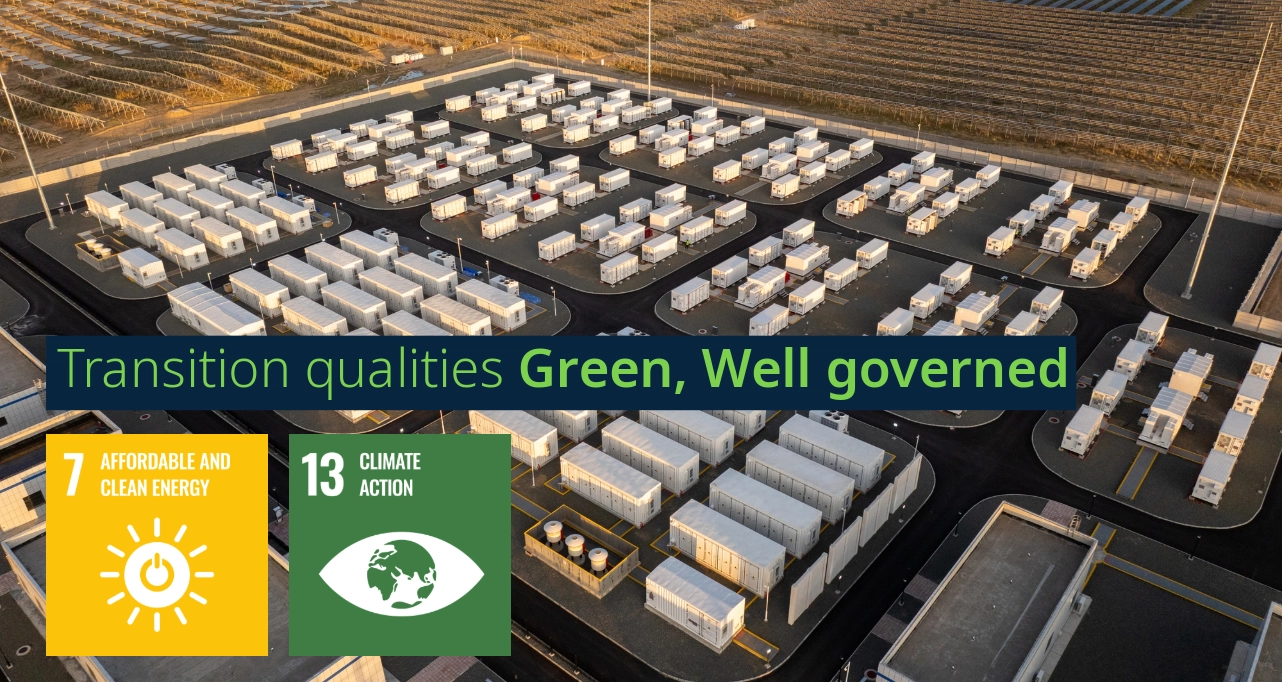
Efforts to strengthen the stability and independent functionality of the Baltic power system are under way, with the first of two 100 MW BESS that will make up the Baltic Storage Platform near Tallinn already operational and construction of the second unit progressing. Both are financed by the EBRD, Edmond de Rothschild Asset Management and the Nordic Investment Bank. Rather than relying on long-term, fixed-price contracts, the projects will run on a fully merchant basis without depending on government support schemes, demonstrating a commercially viable model for such developments while introducing more sophisticated risk allocation.
2,200 MW
estimated increase in renewable capacity in the Baltic states thanks to EBRD-supported projects signed in 2022-25
Encouraging private investment
by aligning public and private incentives and reducing policy uncertainty
Structural shift
in the market towards project financing that is subsidy‑free and based entirely on merchant revenue
Building long-term energy security and sustainability, the EBRD has contributed to a shift in how the Baltic energy sector is financed, governed and operated.
Following the 2022 energy crisis, the Baltic renewable energy market moved decisively away from its traditional reliance on state-supported utilities and towards private‑sector equity and project finance. The EBRD’s engagement has supported the development of private and independent energy companies to further enhance energy markets. Its minority equity investments have helped unlock financing capacity that would not otherwise have materialised, enabling developers to retain and operate assets under more competitive merchant conditions. The Bank’s early anchor role in IPOs has also facilitated the entry of international investors, although some outcomes have proved reversible where government commitment to partial privatisation has weakened.
EBRD‑supported transactions have also contributed to market diversification beyond state utilities, including strengthening IPPs as part of a shift towards commercial models that monetise electricity output. The growth and scaling up of private participation in the Baltic energy market since 2020 has shown that new projects can be financed at or below conventional generation costs, even without subsidies – a significant shift. By providing support for strengthening the governance and balance sheets of IPPs, such as Green Genius and Sunly, the Bank has enhanced IPPs’ capability to engage in power purchase agreement (PPA)-based or merchant financing.
First‑of‑their‑kind investments in standalone BESS with subsidy‑free financing and financing based entirely on merchant revenue marked a structural shift, demonstrating the projects’ bankability in a high‑risk environment. These projects have since informed lender risk assessments and encouraged replication by other market participants. Renewable investments that replicate the market-based revenue model have continued across the Baltic states, signalling a shift towards commercial financing and reduced reliance on state subsidies.
EBRD technical cooperation on sustainable financing instruments and EU taxonomy implementation has improved policy credibility and coordination in the region. Rather than introducing new regulation, these efforts have helped to translate established EU energy and climate objectives into bankable investment pipelines, aligning public and private incentives and strengthening the enabling environment for private investment by reducing residual policy uncertainty.
The strong enabling environment in the Baltic states – including EU regulatory alignment, credible climate commitments and mature legal institutions – provided a foundation for market‑based solutions. The added urgency around energy security from 2022 increased the political momentum for reform and investment in system resilience, highlighting the importance of execution readiness and market conditions.
Flexibility in the financial instruments deployed – equity, project finance and corporate lending – helped the EBRD respond to different market gaps and stages of developer maturity. The Bank’s willingness to engage in higher‑risk segments in periods of market dislocation helped sustain investment momentum when private capital was constrained. The Bank added unique value by shifting from catalytic finance to the role of essential financier after 2022 by providing long‑tenor debt, equity and risk‑mitigation tools where private finance withdrew.
Strategic partnerships also played a key role. InvestEU guarantees enabled first‑loss risk coverage for BESS projects in Estonia and onshore wind development in Latvia, while co‑financing with other international financial institutions and institutional investors helped scale up impact. The EBRD’s close coordination with authorities, municipalities and transmission system operators ensured consistency between investments and policy objectives.