
Read our Cookie policy here.
Search
Search

 Eng
Eng
 Eng
Eng
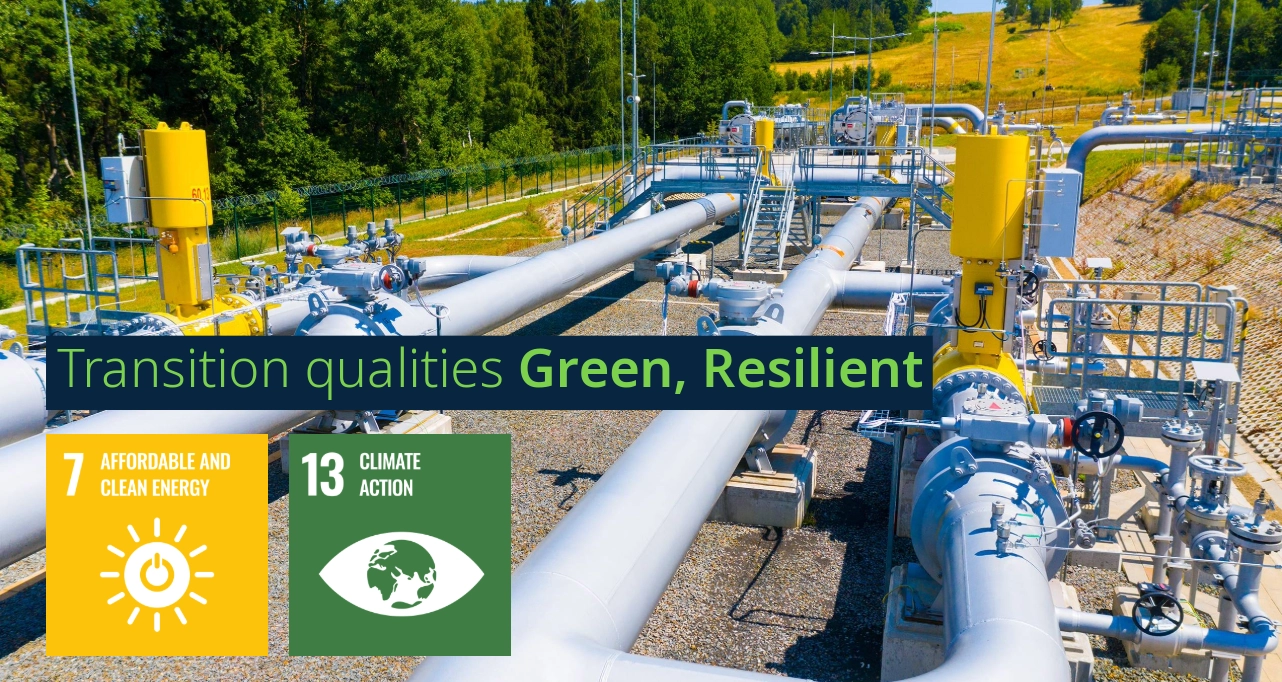
Ukraine’s energy sector has faced unprecedented destruction since Russia’s full-scale invasion began in February 2022, with severe damage to electricity, gas and heating systems. The country’s power generation capacity fell by around 70 per cent in the first two years of the war, leading to rolling blackouts, while damage to state-owned Naftogaz’s facilities contributed to Ukraine having record-low levels of gas in underground storage, creating a need for emergency gas imports.
The attacks have undermined the reliability and affordability of energy supplies that are essential to all sectors and which underpin jobs and livelihoods. They have also jeopardised government revenues at a time of heightened economic pressure – prior to the war, the energy sector, largely associated with state-owned enterprises, generated around 13 per cent of Ukraine’s gross domestic product. In addition, the attacks have impacted other countries, as Ukraine is a major energy producer and hosts some of Europe’s most important facilities for storing and transferring energy.
The EBRD has strategically combined short-term crisis response to support Ukraine’s immediate needs – such as emergency winter gas purchases and the repair and protection of grid infrastructure – with long-term investment and policy efforts to build lasting energy resilience.
As at the end of 2025, the Bank had accounted for around one-third of total international investment to support Ukraine’s energy sector during wartime, deploying more than €3.2 billion in emergency finance and long‑term investment. This was made up of €2.6 billion in loans and over €600 million in grants and concessional finance, enabled by strong support from donors.
The Bank’s emergency support for energy security has included:
Emergency gas supplies: around 10 per cent of Ukraine’s annual wartime gas consumption was covered by EBRD-supported financing to Naftogaz in 2025 – with the EBRD helping to procure 2.3 billion m³ of gas, The almost €1 billion in funding included the EBRD’s largest single loan in Ukraine of €500 million – supported by a 90 per cent guarantee from the EU’s Ukraine Investment Framework and €219 million in Norwegian grants. Since the start of the war, the EBRD has helped Naftogaz to procure close to 4.1 billion m³ of gas.
10.4 million
individuals benefiting from maintained or improved energy/electricity access
1,063
affected firms with improved energy access or energy generation capacity
While the EBRD has provided much-needed wartime support to help maintain access to energy for Ukraine’s businesses and people, it is also helping to advance the country’s longer-term energy security objectives, such as decentralising energy assets and improving the governance of state-owned enterprises (SOEs).
A systemic shift towards renewables in peacetime will require an improvement in Ukraine’s ability to attract private investment at scale. Through the Renewable Acceleration and Market Development for Ukraine Programme (RAMP-UP),1 the EBRD is working to deliver this change.
RAMP-UP, which the Bank is developing with the EU, the World Bank and other partners, is setting up a donor-funded mechanism to support revenue stability for renewable energy generators in the short term, while encouraging reforms to enable the shift to a national support scheme that can attract investments at scale in the medium to long term.
Also supporting renewables, BESS introduced with EBRD assistance during wartime will have longer-term benefits for Ukraine’s energy diversification and green future, as these systems help to balance intermittent renewable energy supplies and will be increasingly needed as renewables expand.
In addition, EBRD loans to bolster distributed power supply are helping to counteract the vulnerabilities created by centralised energy generation and make Ukraine’s electricity network more resilient. Ukraine lost around 90 per cent of its flexible generation capacity between the start of the war and the end of 2025. Over the same period, the EBRD financed 900 MW of new decentralised capacity.
The long-term future of Ukraine’s energy sector has also been bolstered by ongoing work to improve the governance of state-owned energy companies, including Naftogaz, Ukrenergo, and Ukrhydroenergo, which has been a long-term focus of the EBRD’s work in the country. The passage of the SOE Corporate Governance Law in February 2024 was a landmark achievement, strengthening Ukraine’s framework to enhance the autonomy, transparency and accountability of SOEs. It empowered SOEs to approve strategic plans and to appoint and dismiss chief executive officers (CEOs), introduced enhanced disclosure requirements, and defined grounds for the early dismissal of board members to prevent arbitrary actions by the state.
The EBRD and its international partners will continue to advance a systemic energy‑sector reform agenda in Ukraine, in close alignment with a government drive to enhance energy security and the green transition.
Since the onset of the war in 2022, more than €3.4 billion has been secured for Ukraine from over 20 donors. This included €309 million in donor guarantees from the EU, Norway, the United Kingdom and the United States of America, and €133 million in investment grants from the Netherlands, Norway and the United States for emergency repairs to Ukrenergo assets damaged by Russian attacks. In 2025 alone, the EU contributed €604 million under the Ukraine Infrastructure Facility (UIF), which mostly supported emergency gas procurement for Naftogaz and Ukrhydroenergo hydropower-plant repairs. The EBRD’s financing for Naftogaz has been backed by bilateral guarantees from Canada, the EU, France, Germany, the Netherlands, Norway and the United States, and €408 million in grants from Norway. Donors also supported Ukraine in its efforts to diversify its energy sector and help companies, SMEs, municipalities and households to reduce their energy needs and tap into alternative energy sources.
The coordination of efforts across bilateral and multilateral stakeholders has been key to ensure effective and timely support for Ukraine in wartime. The EBRD’s active engagement with and participation in the G7 group of nations, the EU, the Ukraine Donor Platform and sectoral working groups has contributed to a general alignment of priorities and helped to accelerate the mobilisation of financing, technical assistance and policy reform, including in the energy sector.
The EBRD’s approach also relies on long-term engagements with energy operators including Ukrenergo, Naftogaz and Ukrhydroenergo. Combining investment with technical assistance and policy engagement, the Bank is supporting these companies in restoring infrastructure, strengthening operational performance and enhancing corporate governance gaps, where needed, thereby helping to lay the foundations for a more resilient energy sector and a better-functioning, more transparent market.
Rapid and decisive actions are needed to fix weak governance, which raises systemic risk for energy security, public trust and donor trust. The EBRD, together with the G7 and international financial institution partners, has advocated for the swift, orderly and transparent reappointment of Energoatom’s supervisory board, with international observation to restore credible oversight. A recommended corrective agenda outlines a sequence of reforms, including company charter amendments, merit-based CEO selection and a reset of internal controls, procurement and anticorruption systems.
1. Previously called the Ukraine Renewable Energy Risk Mitigation Mechanism.