
Read our Cookie policy here.
Search
Search

 Eng
Eng
 Eng
Eng
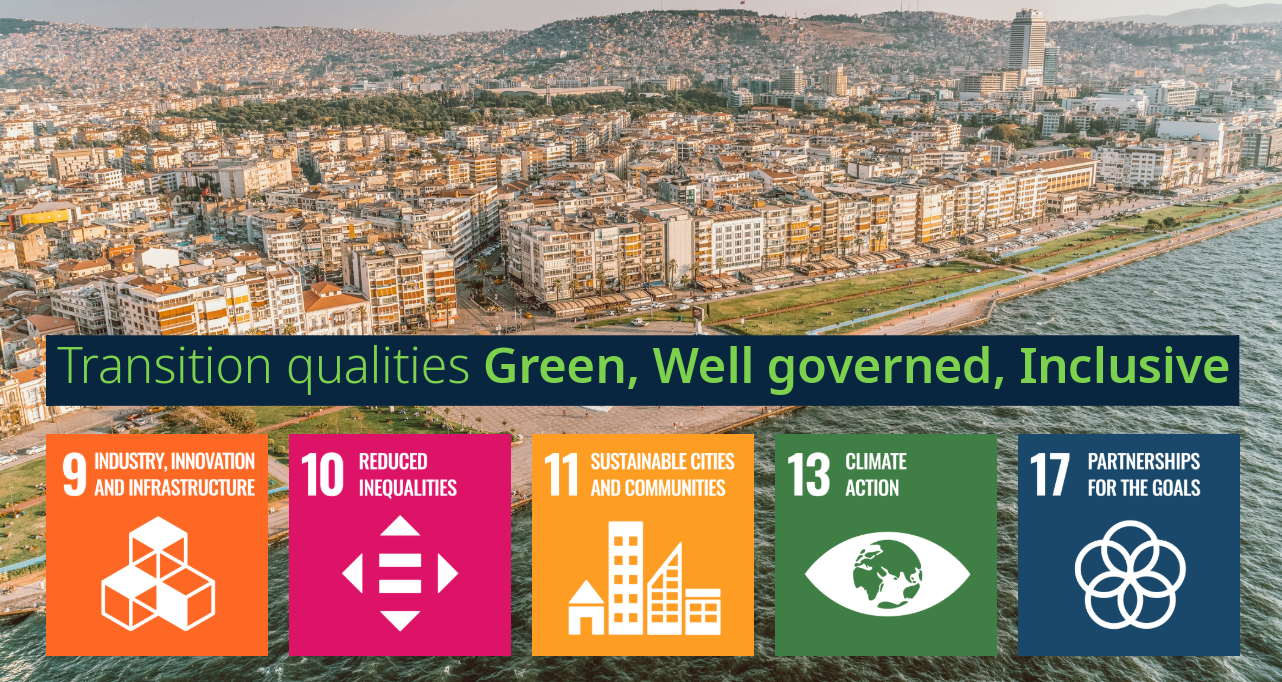
Rapid urbanisation and rising population density in metropolitan areas across Türkiye have escalated the country’s climate challenges. From water scarcity and extreme heat to traffic congestion and worsening air pollution, pressures are mounting, and municipalities are seeking solutions. Coherent climate mitigation and adaptation strategies require several elements – integrated planning tools, systematic prioritisation mechanisms and technical capacity to design, finance, and implement each of these elements. Shortfalls in these areas left the Turkish authorities trying to work with fragmented planning and limited data, while also hampered by insufficient alignment between municipal investments and national climate objectives.
The EBRD’s Green Cities programme has worked to scale up urban climate action across six of Türkiye’s 10 largest cities. Istanbul, Ankara, Izmir, Bursa, Gaziantep and Mersin have a combined population of 31 million people, roughly one-third of the national total as at the end of 2025. The EBRD’s unique combination of investments, advisory work and policy engagement has helped these cities fill gaps in planning, financing and institutional capacity, enabling them to build bankable, climate-aligned investment programmes and benefit their entire populations.
Eleven climate-aligned municipal investment projects had been signed by the end of the first quarter of 2026, targeting improved transport, water, wastewater and renewable energy systems. Worth a combined €884 million, they included expanding the Istanbul Metro to increase low-emission sustainable public transport capacity, developing water-treatment infrastructure in Bursa to improve service quality and environmental outcomes, and pioneering municipal solar energy investments in Gaziantep, reducing carbon intensity and supporting Türkiye’s clean energy transition. These investments have helped to create more efficient infrastructure systems while reducing emissions potential and improving service delivery.
€884 million
of investments targeting improved transport, water, wastewater and renewable energy systems
6 Green City Action Plans
enhancing municipal planning capacity and setting concrete actions for sustainable developments
Türkiye’s first climate law
came into force in July 2025 following extensive EBRD consultations
EBRD advisory work has helped each of the six municipalities develop Green City Action Plans (GCAPs), enhancing municipal planning capacity with concrete actions for sustainable city developments. The EBRD has signed follow-on investments in Izmir, Gaziantep and Ankara, aligned with their respective GCAPs to translate them into action. Prepared using the Bank’s globally recognised methodology, the GCAP approach has become a reference point for other Turkish cities, several of which have shown interest in joining the Green Cities network. The Bank’s advisory services have also strengthened climate data collection, prioritisation, sustainable infrastructure design, investment planning and stakeholder engagement.
On the policy engagement front, Türkiye’s first climate law came into force in July 2025 following extensive EBRD consultations. This landmark document has ushered in a shift in approach to tackling the impacts of climate change, with adaptation and mitigation becoming integrated into planning for all of the country’s 81 provinces. Provincial climate change coordination boards have also been established and are preparing action plans for areas of their work that align with national climate policies, representing a major step towards institutionalising climate governance nationwide.
The EBRD’s investment and assistance projects are triggering long-term transformational shifts in Türkiye’s urban climate governance.
The success of GCAP-driven climate investments in both economic and environmental terms is providing a model that other cities and consultants are emulating to remain competitive. Novel projects, such as the municipal-level solar installations rolled out in Gaziantep, are setting a benchmark for others to aspire to, while the introduction of integrated urban climate planning tools are establishing new national norms.
The climate law is also embedding GCAP-like requirements nationwide, institutionalising climate planning obligations and creating an enabling environment for sustainable investments. The spread of green projects throughout the economy is also boosting green jobs and skills, helping build population-level buy-in that will sustain a systemic shift within the economy. Municipal staff who have benefited from training through GCAPs are acting as internal champions, helping others to learn climate planning practices, while climate specialists trained through GCAP processes are raising national capacity as they move across municipalities and consultancy firms.
All of this is increasing visibility and awareness of urban climate issues and the ways to tackle them.
Many large cities in Türkiye long had the political will to improve their environmental performance. The introduction of the EBRD Green Cities programme and its GCAP approach helped equip them with the tools to turn their ambition into action, and the strong demonstration effect created by the success of the scheme helped build national momentum for climate action. The 2025 climate law was the culmination of this, marking the start of sustainable systemic change.
While the EBRD’s integration of investment assistance with advisory work and policy dialogue helped create coherent and credible climate plans, strong levels of municipal ownership transformed this promise into progress, and turned plans into bankable projects. Collaboration was crucial at every stage, bringing the Bank together with metropolitan municipalities, national ministries, local utilities, experts and consultants to create context-relevant strategies that could create immediate impact.
The main lesson learned was that setting a successful – and visible – example has a multiplier effect across economies. Running multi-city programmes generated significant opportunities for peer learning that accelerated systemic change, while the visibility of early projects, such as metro extensions and pilot solar developments, secured political buy‑in and a desire to do more or emulate their success. The early alignment of Green Cities initiatives with national policy frameworks also accelerated impact and replication, while ongoing capacity building created role models for people to follow and ensured that GCAP preparation and implementation maintained momentum.
| EBRD’s contribution | Market dynamics | Systemic change |
|---|---|---|
|
|
|