
Read our Cookie policy here.
Search
Search

 Eng
Eng
 Eng
Eng
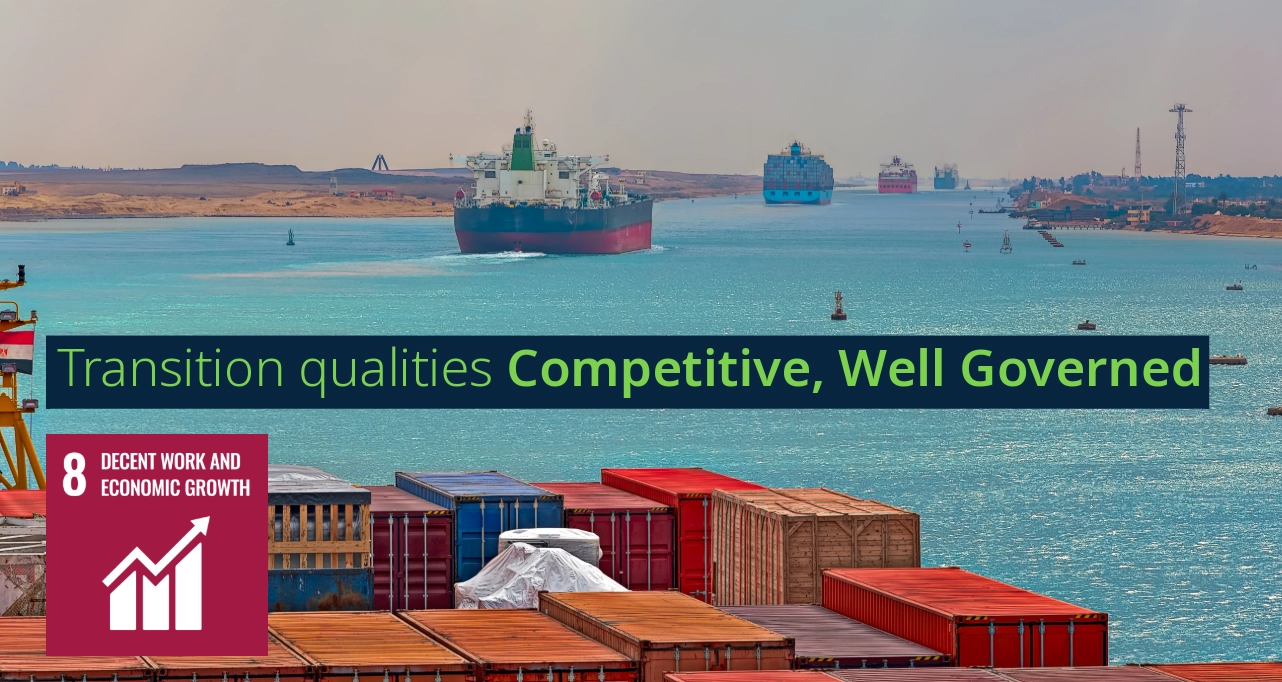
Established in 2015, the Suez Canal Economic Zone (SCZONE) was Egypt’s first special economic zone. Created to maximise the economic potential of the Suez Canal corridor and position Egypt as a global hub for trade, industry and logistics, the SCZONE is intended to attract and retain investors by offering a streamlined, business-friendly environment supported by incentives such as customs and tax exemptions, training support and utility cost subsidies.
Spanning 455 km² along one of the world’s most strategic shipping routes, the zone is governed by an autonomous authority with executive and regulatory powers, and encompasses four integrated industrial areas, as well as six seaports and two airports. Around 20 per cent of international container trade passes through the Suez Canal each year, highlighting the SCZONE’s potential to anchor Egypt more deeply into global value chains.
Despite the zone’s autonomous governance model and broad package of investor incentives, ongoing improvements in procedural efficiency and transparency were needed to simplify access for investors so that the SCZONE could unlock its full potential. With international organisations consistently highlighting the importance of administrative reform and private sector‑oriented governance to support sustainable growth in Egypt, enhancing the efficiency and transparency of investor services within the SCZONE became a strategic priority. This also aligns with Egypt’s broader Vision 2030 economic reform agenda, including the country’s transition towards a data-enabled society by digitalising government services to improve efficiency, transparency and accessibility.
The EBRD has partnered with the SCZONE since 2020, helping it to develop a more efficient, competitive and investor-friendly business environment in pursuit of its ambition to become a world-class investment hub.
The Bank’s engagement has focused on two closely linked priorities:
Simplifying investor facing procedures
Fully digitalising its one-stop-shop (OSS) service platform for incorporating companies
The first phase of EBRD support centred on re‑engineering 20 priority investor services, including construction permits, operating licences, industrial registration, practice permits and inspection processes. It also included an information and communications technology capacity assessment, which provided the foundation for the design and development of the digital platform in a second phase. The initial project delivered tangible efficiency gains; launching in August 2020 and reaching completion in 2022, it reduced the number of administrative procedures by 35 per cent and cut service delivery times by 52 per cent across targeted services. The resulting improvements in efficiency, responsiveness and predictability for investors have strengthened the SCZONE’s competitiveness.
Building on this progress, the second phase launched in February 2023 to expand these reforms to a further 60 services, covering areas such as land management, project approvals, environmental permits, company registration and foreign-worker authorisation. Full digitalisation of the OSS was included in this phase, including workflow automation and the introduction of a business intelligence dashboard to support data‑driven management. Consultants also provided targeted technical training to the SCZONE’s Investor Services Department to ensure effective implementation and sustainability.
The phased transition from paper-based administration to a digitalised, data-driven investor service model marked a significant milestone in creating a more streamlined governance process and business-friendly environment that supports the competitiveness of the SCZONE for foreign investment. The digital OSS has delivered strong early results, with its digitalised Investor Account Activation platform processing 89 investor activation requests and successfully activating 82 investors with an average processing time of two days. This is a significant improvement from pre-reform processes, which were largely manual, f
ragmented and took considerably longer, depending on the service. This step change in the speed and transparency of investor service delivery has strengthened the SCZONE’s attractiveness to investors.
130%
rise in the number of registered investors between 2020 and 2025
€12.7 billion
of investments as at February 2026, with 70% from foreign investors
52%
reduction in service delivery times, strengthening the SCZONE’s competitiveness
The EBRD’s support for digitalised governance reforms in the SCZONE has created conditions more conducive to foreign direct investment (FDI) and private-sector growth. The zone’s more efficient, transparent delivery model, enabled by data-driven decision-making, has removed administrative barriers to investment. It has also triggered a broader institutional shift in the SCZONE’s regulatory model and investment governance.
The result has been a marked increase in investment activity. The number of registered investors rose by around 130 per cent between 2020 and 2025, from 270 to 619. As at February 2026, total investments had grown to US$ 15 billion (€12.7 billion), of which 70 per cent originated from foreign investors in 28 different countries, demonstrating the SCZONE’s competitive repositioning in the international market.
The digitalisation of the OSS and business intelligence dashboard has set new standards for economic zones in Egypt, creating one of the most advanced investor service models in the country and raising the benchmark for investment governance and administration. In line with Egypt’s Vision 2030 targets for digitalising government services, the project has demonstrated how technology‑enabled service delivery can strengthen competitiveness and efficiency. It also offers a model of technology-enabled administration that can be replicated by other economic zones, industrial parks and investment authorities seeking to remain competitive in attracting FDI.
More generally, the combination of process re-engineering, digitalisation and staff capacity building has transformed the SCZONE from a person‑dependent service model into a system‑dependent one. Institutional knowledge and best practices have been embedded in the operating procedures and are also gradually diffusing across the country as trained staff interact with peers across government entities or move between institutions, supporting broader administrative reforms to improve Egypt’s investment climate.
Several factors underpinned the success of the SCZONE reform programme. A favourable policy environment and strong government commitment to economic modernisation through the Vision 2030 agenda provided a clear mandate for administrative reform, while the SCZONE’s autonomous governance structure enabled reforms to be implemented effectively. Strong client ownership was also critical, with the SCZONE leadership’s active championing of the digital transformation and service optimisation agenda helping to overcome resistance to change and sustain momentum.
Alignment between the EBRD’s technical assistance and Egypt’s national development priorities helped secure sustained political and institutional buy‑in, and this was supported by a phased implementation approach that delivered early wins, helping build confidence in the project within the SCZONE and allowing reforms to be refined iteratively.
The EBRD’s ability to draw on international best practice from comparable economic zones ensured that recommendations were credible, practical and tailored to the local context. At the same time, the close partnership between the EBRD and the SCZONE was a cornerstone of delivery, combining the Bank’s expertise in investment climate reform with the zone’s institutional authority and operational knowledge. This collaboration helped anchor technical solutions within existing workflows and institutional realities, increasing the likelihood of long‑term change taking root.
Together, these lessons provide a blueprint that can inform similar efforts to modernise investor service delivery in Egypt and other countries.