
Read our Cookie policy here.
Search
Search

 Eng
Eng
 Eng
Eng
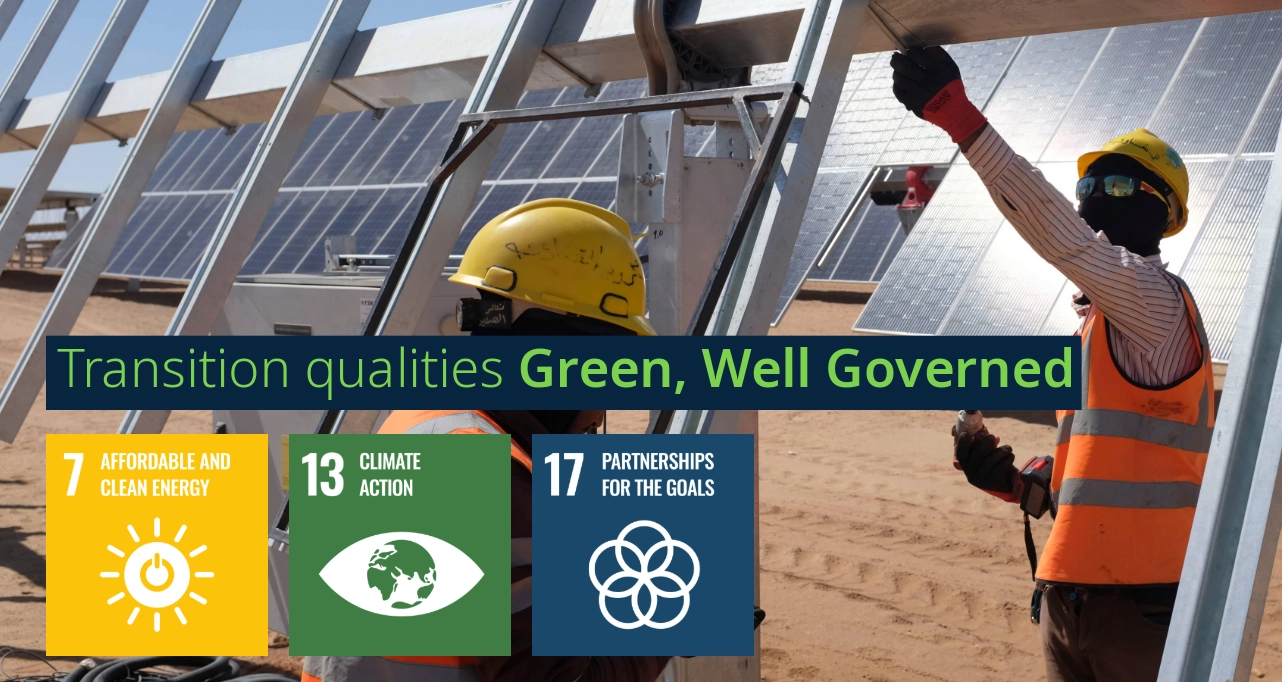
Egypt has set out ambitious plans to green its economy, including large increases in its use of clean energy. As recently as 2024, just 11 per cent of its electricity came from low-carbon sources, significantly below the global average of 41 per cent, but the country has ambitions to raise this to 42 per cent by 2030.
A series of obstacles need to be overcome to achieve this, from rapidly boosting renewable generation, reducing dependency on fossil fuels and modernising grid infrastructure, to building green skills and using policy frameworks to attract private-sector investment.
Egypt’s main tool for driving this change is its Nexus of Water, Food and Energy (NWFE). Launched in 2022 when the country hosted the COP27 climate talks, this flagship decarbonisation initiative is a strategic blended finance mechanism aligned with the country's National Climate Change Strategy 2050 and its updated Nationally Determined Contributions (NDCs) under the Paris Climate Agreement.
The EBRD is lead partner of the NWFE’s energy pillar. Through the coordinated programme, the Bank is helping to tackle the core structural constraints to Egypt’s energy transition through a combination of investments, policy engagement and technical assistance. The results of this approach are already visible across multiple dimensions of Egypt’s energy sector.
Progress on decommissioning thermal power plants to free up grid space for renewable energy capacity has already led to positive results. More than 1 GW of inefficient fossil fuel generation has been permanently closed, out of the estimated 5 GW that needs to be decommissioned to enable renewable capacity. The EBRD-supported Decommissioning Master Plan and Just Transition scoping study are ensuring the shutdowns meet international standards for environmental, technical and worker transition management, reducing execution risk and establishing implementation guidelines for future decommissioning. This marks one of the first large‑scale, planned decommissioning exercises in the region.
5.15 GW
of renewable capacity mobilised
7 million households
powered by clean energy
As of March 2026, more than 10 GW of renewable energy power purchase agreements (PPAs) have been signed, with almost 6 GW reaching financial close, involving more than €4.3 billion of private capital. Alongside solar capacity, the EBRD is integrating storage capacity through the development of battery energy storage systems – marking the introduction of a new technology that is not yet common in Egypt but that has the potential to be replicated across the country.
The Bank has helped state-owned Egyptian Electricity Transmission Company (EETC) to structure and launch five renewable energy tenders, increasing competition and transparency in the renewables sector. One of these tenders, for a wind project, followed EBRD support for a wind measurement campaign by Egypt’s New and Renewable Energy Authority at a site in the West Sohag area. The site is expected to have strong potential for wind energy, and the study provided bankable data and accelerated the process for land allocation, helping EETC to launch a tender for a 1 GW wind project.
EBRD financing has also continued to spur momentum for renewable development – its involvement in five wind and solar projects with combined capacity of 3.5 GW has helped crowd in US$ 2.5 billion (€2.1 billion) of private-sector investment. Together, these investments have demonstrated Egypt’s ability to mobilise large-scale private renewables under competitive, transparent conditions, helping it to pursue its NWFE target of adding at least 10 GW of wind and solar capacity.
Egypt’s progress on grid reinforcement has moved from planning to execution. Through a combination of EBRD investments and mobilised concessional finance from partners including German development bank KfW and French development bank AFD, around €350 million has already been structured to reinforce transmission infrastructure critical for integrating new renewable capacity. These investments are directly linked to system bottlenecks identified through NWFE planning, including transmitting wind power from the Gulf of Suez and maintaining network stability as thermal generation is retired.
More generally, the NWFE aims to create the conditions to attract private-sector investment at scale, mobilising the necessary financing for Egypt to realise its green transition ambitions. EBRD technical assistance for electricity market regulator EgyptERA has helped to develop private-to-private (P2P) contractual mechanisms to move Egypt beyond the single-buyer model in electricity markets. By March 2026, this model had led to three pilot P2P projects with combined capacity of 300 MW.
The Bank’s advisory work has also supported the development of a green supply-chain roadmap aimed at attracting foreign direct investment and fostering diversified, resilient renewable energy value chains. It is also helping Egypt to establish energy attribute certificates to prove electricity was generated using renewables, with the aim of enhancing export competitiveness, particularly with EU markets.
As at March 2026, the NWFE energy pillar was estimated to have supported the mobilisation of 5.15 GW of renewable capacity capable of generating 18.4 TWh of clean electricity annually – enough power to more than 7 million households. This will also enable the avoidance of approximately 9.4 million tonnes of CO₂ emissions per year.
The systemic impact of the NWFE energy pillar can be seen in the re-orientation of incentives and frameworks across Egypt’s power sector. Instead of relying on ad hoc negotiations and state‑led capacity additions, the market is increasingly responding to clear rules, competitive processes and credible transition planning.
Renewable project developers have signed more than 10 GW of PPAs, signalling strong investor confidence and a structural shift towards private sector-led power generation. At the same time, the permanent closure of over 1 GW of thermal capacity marks a decisive move from incremental optimisation towards structural system reconfiguration. The introduction of the P2P framework and open tenders is shifting Egypt away from a state-dominated electricity model towards greater private-sector participation and competitive procurement mechanisms.
Technical studies and pilot deployments under the NWFE have reduced information asymmetries that previously delayed investment. For example, bankable wind measurements at West Sohag directly supported land allocation decisions and triggered a wind tender. In the medium term, this pilot should support future land allocations and shorten development timelines, while reducing early‑stage risk and cost for investors.
Capacity building across institutions, including EETC and EgyptERA, is creating transferable expertise in decommissioning, auction design and system integration, supporting sustained reform beyond individual transactions. It is also helping to spread global best practices and accelerate the use of new technologies.
The launch of successful renewable and hybrid projects – including the introduction of solar plants with battery storage – is accelerating market replication and expanding project pipelines by demonstrating technical and commercial feasibility. The early-stage development of green supply chains and certification systems is also reshaping incentives across the entire market, not just project participants, and elevating Egypt’s position in emerging clean energy markets.
Unlocking private investment, the NWFE Energy Pillar had mobilised US$ 5 billion by the end of March 2026, half of its target for the end of 2028, demonstrating effective de-risking and the crowding in of private capital. The large-scale entry of private developers and open tenders is pressuring existing and new players to adopt more efficient models, deepening market competition.
As a country platform, the NWFE was an essential mechanism in bringing together the authorities, investors and partners around a common agenda and set of clear objectives. Egypt’s strong commitment to the energy transition and clear vision, including accelerated renewable targets, has been crucial to the platform’s success to date. The NWFE’s alignment with national strategies is ensuring long-term policy continuity, while its platform-based approach is enabling coordination across EBRD investments, policy dialogue and technical assistance.
The NWFE’s high visibility has also built trust among the private sector, while the use of blended finance and concessional instruments has helped to attract private capital by de-risking investments. The success of the first private-sector renewable developers has also played a key role in scaling up investments by validating the market model.
The coordinated engagement of development partners and donors has been instrumental in translating ambition into achievement. This has included support from bilateral donors (such as the European Union, France, Germany and the United Kingdom) for technical assistance, enabling advisory work, grants and concessional finance. This has facilitated knowledge exchange, adherence to global best practices and the introduction of innovative financing instruments, such as performance-based grants (for example, incentive payments for decommissioning), concessional finance and crowding in private finance at scale.
The platform-based approach has supported regular information exchange and joint engagement, which has continuously strengthened coordination between all stakeholders. This has ultimately helped to enhance alignment, avoid duplication and ensure resources are used efficiently.