Search
Search
Who we are
Overview: about the EBRDWho we are
Overview: about the EBRD
Learn about the EBRD's journey to investing more than €220 billion in over 7,800 projects.
What we do
Overview: how the EBRD operatesWhat we do
Overview: how the EBRD operates
Across three continents, the EBRD supports the transition to successful market economies.
Work with us
Overview: how you can work with the EBRDWork with us
Overview: how you can work with the EBRD
We draw on three decades of regional knowledge and financial expertise to tailor our products and approaches to each client's needs.

 Eng
Eng
 Eng
Eng
March 2016
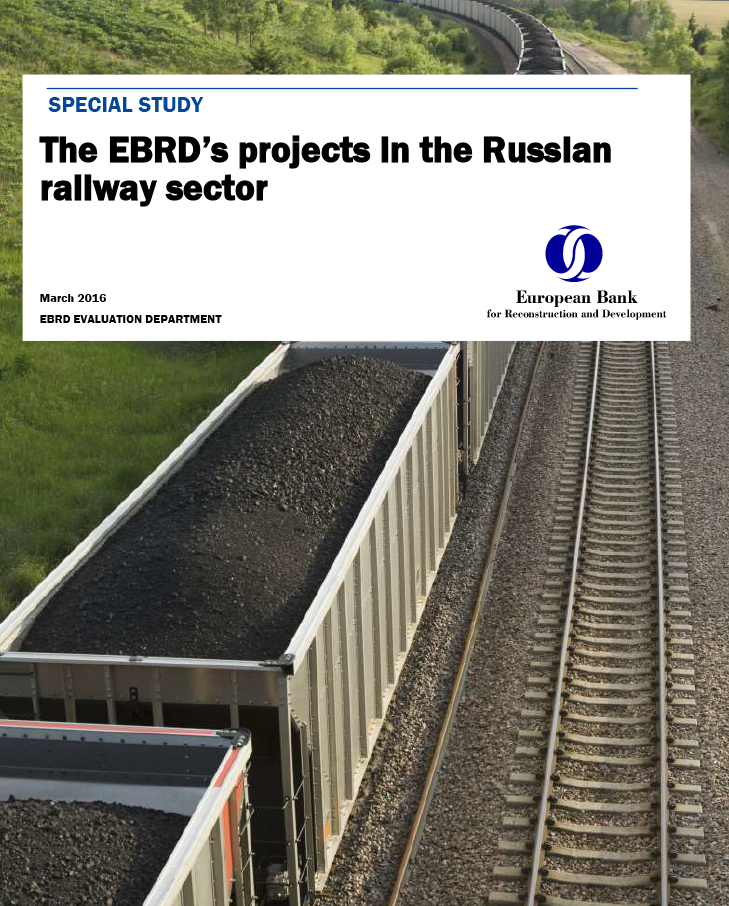
The EBRD Evaluation Department (EvD) evaluated the EBRD’s operations in the Russian railway sector carried out from 1996 to 2013. The portfolio includes 24 rail projects worth €1.8 billion and 34 TC initiatives worth €6 million. EvD assessed relevance, results and efficiency of the activities to produce an overall assessment rating. Several findings lessons and recommendations were made to inform future Bank work.
The EBRD’s Russian railway portfolio performed well across the multiple dimensions of the Bank’s operational mandate. EvD rated overall performance good bordering on outstanding; based on fully satisfactory relevance, results, transition impact and sound banking. Efficiency and additionality were excellent. Results were delivered on the ground at both the project and sector level. Strengths of the EBRD’s operations were providing financial additionality and crowding in commercial financing. Russian railway operations demonstrated the principles of sound banking, particularly Bank handling, implementation efficiency and the EBRD’s investment return on the debt portfolio.
The Bank’s integrity management system worked well and succeeded in ensuring that corruption did not infect the Russian railway portfolio. Client companies hold Bank staff in high regard and the increased delegation of responsibilities and staff to the Moscow resident office had a positive impact on the quality of services provided to clients. There were a few areas where actual performance fell short of expectations such as limited support to help complete stalled reforms; use of TC; demonstrated non-financial additionality; limited support to help improve the RZD’s financial performance; the EBRD’s losses on its equity investments in Russian railway companies.