
Read our Cookie policy here.
Search
Search

 Eng
Eng
 Eng
Eng
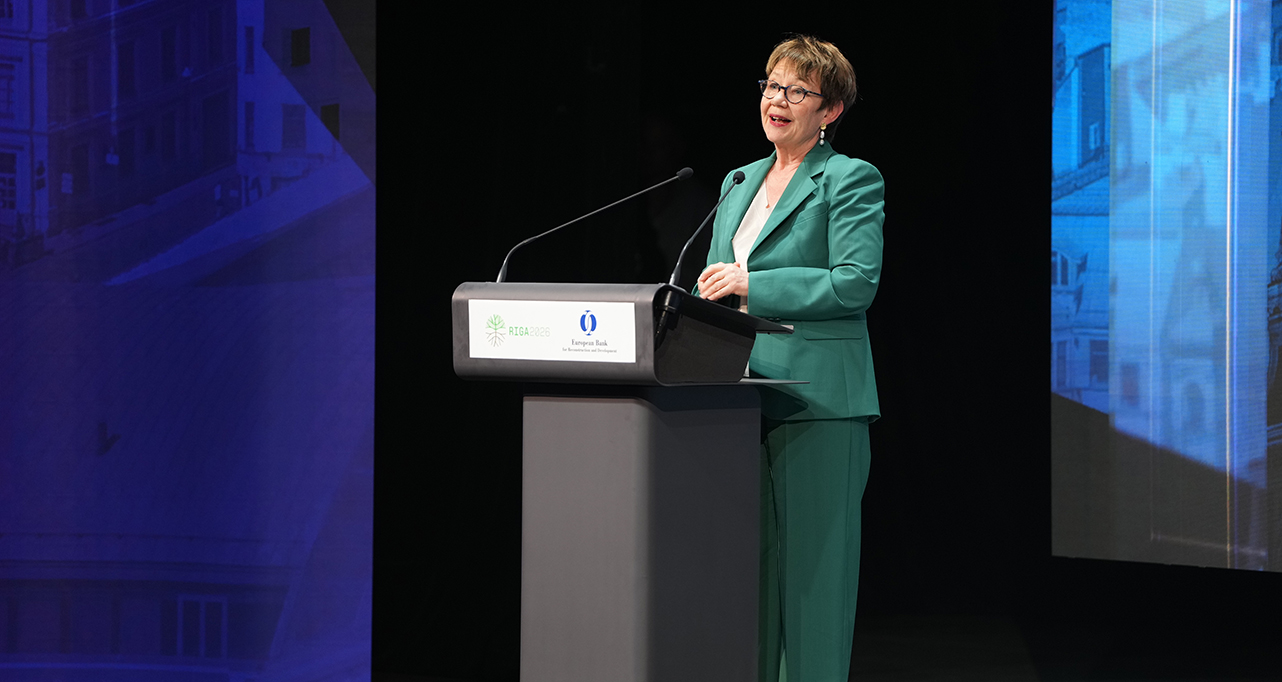
Delivered by: EBRD President Odile Renaud-Basso
Venue: Dailes Theatre, Riga, Latvia
Event: EBRD Annual Meeting 2026
Your Majesty,
Your Excellencies,
Governors,
Colleagues,
Friends.
Welcome to Riga, a city so elegant it has been nicknamed ‘the Paris of the North’. No wonder I feel so at home here!
Latvia is the perfect host for our Annual Meeting and the topic we will focus on.
Together with Estonia and Lithuania, it has been one of the shining stars of transition from centralised to market economies and of EU enlargement.
All three countries are blessed with thriving start-ups, are highly digital and keen adopters of fintech.
In fact, more than much of the rest of Europe.
Such talent for adaptation and innovation has not wavered in times of crisis.
For years, their dependency on Russia for gas and electricity threatened their security.
But when it mattered most, after Russia’s invasion of Ukraine, the three countries fully connected to the EU’s grid.
And they accelerated investment in green energy.
They transformed historical weakness into a source of new resilience.
That is a lesson we should all take note of.
Today we are in the grip of a new shock.
This one started in the energy sector but is already hurting the global economy.
It is disrupting trade, forcing up the cost of many commodities beyond energy and imperilling food security.
Inflation and interest rates are increasing.
Governments’ fiscal space is tightening.
When and how this will end we cannot guess.
But its Scale, Scope and Speed underline how volatile our world has become.
Indeed, I would go further.
The times our regions and many others are living through have gone from volatile to turbulent.
And all this on top of many other fundamental shifts, one the coming of AI, with the major opportunities and risks it brings.
Today I want to focus on what I see as the three main challenges now confronting the EBRD…
And to spell out how we deal with each one.
The first challenge is, no surprises, to help our countries respond to conflict and the resulting crises.
Here we can call on the strengths we share with all multilateral development banks.
When other lenders pull back, we scale up, as we have done in Ukraine.
While safeguarding our financial strengths and carefully managing risk, we continue to invest.
We deliver impact that cuts across whole economies.
And we do so for the long term.
All this informs our response to what has been happening in the Middle East.
In Iraq, Jordan, Lebanon, and the West Bank and Gaza, as well as neighbouring countries affected by conflict, we will support economic activity.
And we will support private sector and state-owned enterprises, providing liquidity and stabilising the financial sector.
In the long term, we will also lay the foundations for growth and sustainable recovery.
These are principles we have already put into practice in Ukraine.
Support for the country remains at the core of what we do.
We are its number one institutional investor.
We have leaned in, increased, not decreased, investment, deploying 10 billion euros there since Russia launched its full-scale war.
Those facts and figures tell some of the story.
But that story must also include the almost 50,000 firms affected by the war who have benefitted from our support over the last four years.
It is also about the more than 22 million Ukrainians, more than half the population, helped by our investments in energy security and infrastructure, as you saw in the video earlier.
We will be at the forefront of international efforts to rebuild the country when the time comes.
And, it, will.
Our second challenge is to uphold the values of international cooperation and partnership in our work.
On a recent trip to Chornobyl, my seventh to Ukraine since the war began, I saw with my own eyes an inspiring monument to such cooperation.
The New Safe Confinement shields the destroyed reactor.
It is a miracle of modern engineering.
We led the world’s largest ever joint effort on nuclear safety, funding its construction.
After last year’s Russian drone strike, however, the international community needs to finance urgent repairs.
Thank you, those who have already come forward to commit funds.
This is only one of many areas where our members contribute, together, to global public goods.
The overwhelming majority of shareholders who subscribed to our capital increase, as well as our donors’ generosity, are impressive illustrations of a commitment to working together.
But we now live in a world of declining development aid and mounting sovereign debt.
Given that, partnering with the private sector becomes even more important.
Last month’s launch of our first significant risk transfer is a taste of more to come.
It allows us to share investments and risks with pension funds and insurers, building on long-term interest in emerging markets.
The world economy is becoming more fragmented.
We can all see this.
We hear and note our shareholders’ concerns about value chains, cybersecurity and fair competition.
Our revised procurement rules address them, while continuing to promote transparent, open, market economies.
The third, and final main challenge is, when confronted with turbulence today, not to lose sight of the long-term.
That means continuing to support our countries’ transformation and delivering effectively as a Bank.
Amidst the turbulence, we see opportunities for our regions.
For example, Central Asia’s and the Caucasus’s ability to connect East and West, Asia and Europe, via the Middle Corridor is more important, geopolitically, than ever.
Another example: diversification of supply has become a strategic priority, creating opportunities for our countries to move up the value chain.
Many of our countries of operation are blessed with abundant sunshine and wind, giving them potential to enhance energy security and to become more competitive.
The last time we met, in London, you, our shareholders, approved an ambitious plan for our work over the next five years.
This plan has been translated into three concrete strategies approved by the board.
I want to thank our board members for their constructive engagement and continued commitment.
We have clear guidance as to what you expect.
We are now turning your priorities into projects and projects into impact.
Thanks to our exceptional staff, we are being ever more versatile in what we do and how we do it.
We will implement our new and strengthened approaches to green investment and to our vital work on human capital and gender equality.
And, importantly, mobilising private funds and speeding up digitalisation.
We already see its potential for accelerating market reform across economies as a whole.
And for helping our regions enjoy a new era of innovation and opportunity.
These are the three main challenges I see for the times we live in.
Responding to conflict and crises.
Upholding international cooperation.
To build a better future, we can call on the Bank’s pioneering spirit - and our staff’s dedication.
Since we last met, we have launched operations in Benin, Cote d’Ivoire, Kenya, Nigeria, Senegal and Iraq.
A year ago I described the sense of ‘excitement within the Bank about what we can bring to these economies’.
That is excitement I have now felt for myself on the ground as we make our first investments.
We have got off to a flying start in our new region…
Just as we did 15 years ago in the Southern and Eastern Mediterranean.
Our new member countries in Africa are very different from our Baltic hosts, with their own needs and ambitions.
But they are also innovating in a changing world.
Their economies are reinventing themselves, with our support, by: securing agricultural value chains, scaling digital services and tackling the infrastructure gap.
Of course, expanding to new markets and integrating new priorities impact our size and budget.
But we are making sure that long-term sustainability and efficiency are at the very heart of our internal changes.
Such are my thoughts on these turbulent times.
I am a realist.
I am under no illusions about the risks our world now faces and the scale of the challenges ahead.
At the same time, I know that our amazing staff, the EBRD as a whole and the countries where we work have the talent and commitment to overcome crises.
We will help our economies become more competitive and more sustainable.
And our Bank will grow stronger, more resilient and more versatile…
Delivering now and for the future.