Search
Search
Who we are
Overview: about the EBRDWho we are
Overview: about the EBRD
Learn about the EBRD's journey to investing more than €220 billion in over 7,800 projects.
What we do
Overview: how the EBRD operatesWhat we do
Overview: how the EBRD operates
Across three continents, the EBRD supports the transition to successful market economies.
Work with us
Overview: how you can work with the EBRDWork with us
Overview: how you can work with the EBRD
We draw on three decades of regional knowledge and financial expertise to tailor our products and approaches to each client's needs.

 Eng
Eng
 Eng
Eng
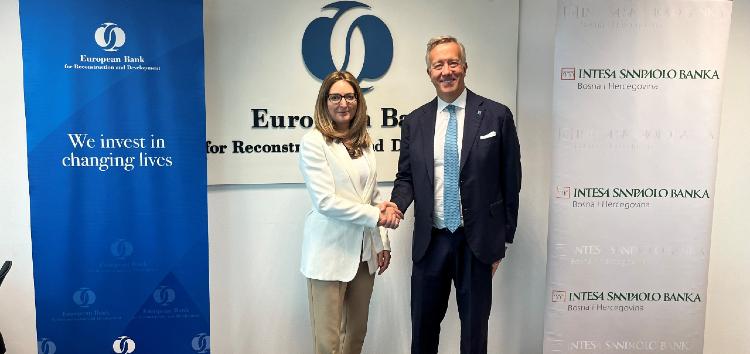
The European Bank for Reconstruction and Development (EBRD) has signed a first risk-sharing framework facility with Intesa Sanpaolo Banka D.D. Bosna i Hercegovina that aims to boost the competitiveness and trade potential of businesses in the country.
The framework is designed to allow the EBRD to share partner banks’ exposure to local enterprises through an unfunded risk participation which is similar to a guarantee and the bank will benefit from an unfunded risk-sharing framework for an open-ended period. The EBRD will guarantee up to 65 per cent of each individual sub-loan that Intesa provides to eligible clients. The Bank’s commitment under the agreement could reach up to €30 million.
The risk-sharing framework will support Intesa Sanpaolo Banka`s strategy for continued business growth in small and medium-sized enterprise (SME) segment, while also allowing it to meet the financing needs of large clients.
Marco Trevisan, President of the Management Board of Intesa Sanpaolo Banka said: “After we recently signed a new Go Green line with our long-term partner EBRD and renewed cooperation on the Go Digital in BiH line for small and medium-sized enterprises, I must say that I am particularly happy about this cooperation, above all because we are the first bank in BiH that will offer our customers this type of product. With the help of this instrument, the Bank will have a more flexible approach, it will increase its ability to assume part of the risk, and it will facilitate the daily challenges faced by all our existing and potential clients from the SME domain, all with favourable financing conditions,"
Intesa Sanpaolo Banka D.D. Bosna i Hercegovina, sixth larger bank in the country, a member of the Intesa Sanpaolo Group, is a long-standing partner of the EBRD.
The EBRD has invested more than €3 billion in 223 projects in Bosnia and Herzegovina since it began operating there in 1996. The Bank’s strategic priorities in the country are to promote the green economy, support the competitive development of the private sector and foster regional integration.