
Read our Cookie policy here.
Search
Search

 Eng
Eng
 Eng
Eng

Sustainable and resilient market economies rely on all people being able to contribute and thrive. Achieving this requires the dismantling of barriers and the creation of a level playing field so every individual can achieve their full potential. With this imperative in mind, the EBRD’s Strategic and Capital Framework (SCF) reaffirms the promotion of human capital and equality of opportunity for all as a core strategic objective for 2026-30.
The Gender Equality and Human Capital Strategy 2026-30 sets out the EBRD's approach to helping people access opportunities, develop skills and participate fully in economic life.
The strategy reflects a simple principle: sustainable market economies perform better when everyone has the opportunity to contribute and thrive.
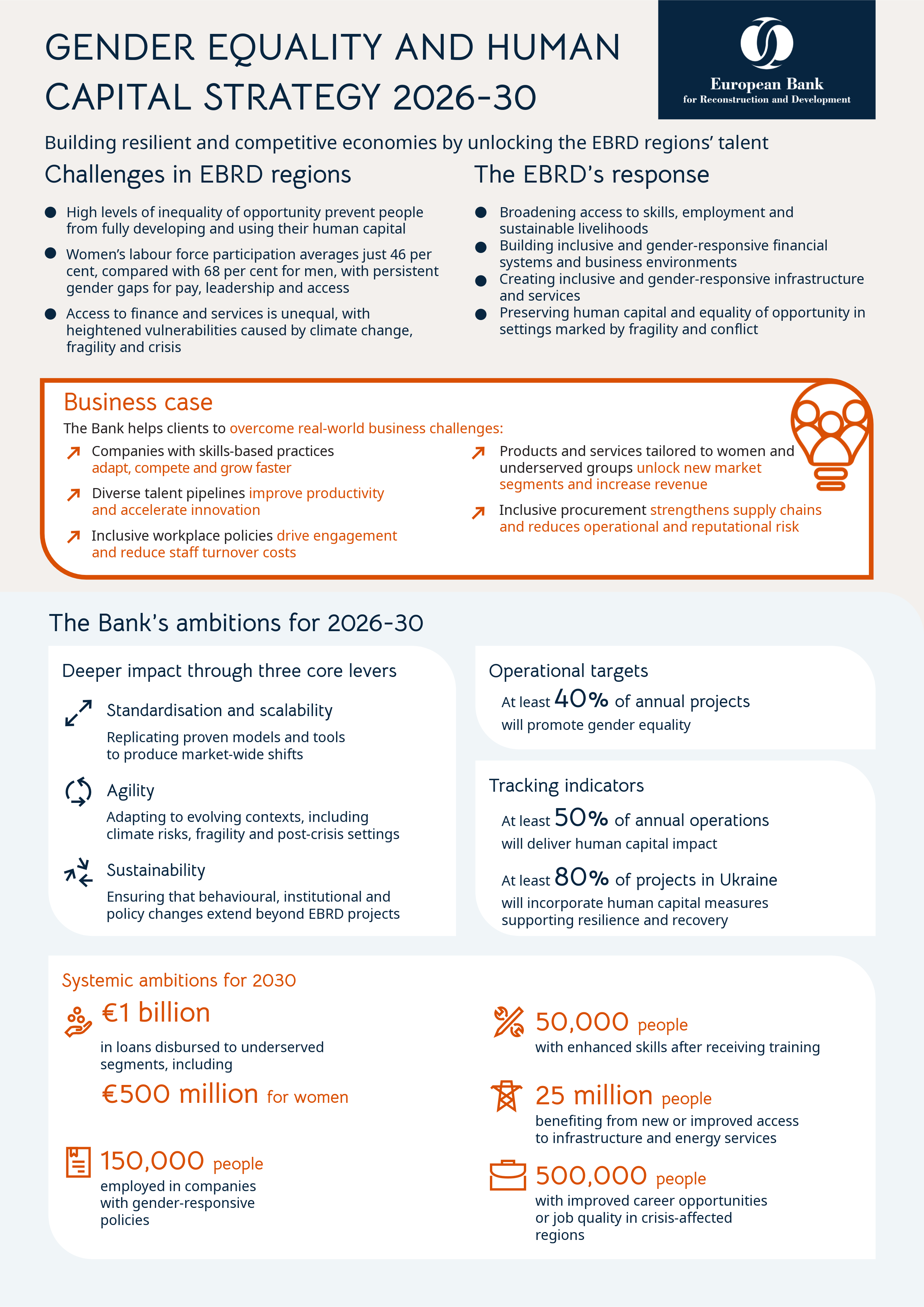
Across the EBRD regions, inequalities in access to employment, finance, services and infrastructure continue to limit economic potential. At the same time, economies face major structural challenges, including demographic change, digital transformation, climate risks and geopolitical instability. The strategy responds to these challenges by focusing on four areas:
The strategy also strengthens the Bank's focus on measurable impact, scalability and long-term change. It maintains the EBRD’s objective of having at least 40 per cent of annual projects promoting gender equality and introduces a human capital impact indicator with a reference point of at least 50 per cent of annual operations.
The EBRD applies a number of cross-cutting lenses to strengthen the impact of its gender equality and human capital activities. These lenses help to ensure that the Bank responds to major economic and societal trends shaping its regions.
The transition to a green economy presents significant opportunities for job creation, innovation and growth. The EBRD works to ensure that women and other underserved groups can access the skills, jobs, finance and opportunities that are emerging from the green transition.
Digital technologies are transforming economies and labour markets. The EBRD promotes digital inclusion by supporting access to digital skills, digital finance and technology-enabled opportunities, such as artificial intelligence, while helping to address tech-related human capital challenges.
Climate change, conflict and economic instability are driving migration and deepening fragility, with vulnerable regions bearing the brunt. The EBRD supports sustainable recovery through financial support, political reform, targeted skills programmes and essential services to boost resilience and build back better.
Equal participation requires safe, inclusive and enabling environments. The EBRD supports clients in strengthening workplace policies, addressing gender-based violence and harassment, and promoting equal opportunity and participation.
Together, these lenses help to ensure that gender equality and human capital considerations are embedded across the Bank's investment, policy engagement and technical cooperation activities.
The strategy introduces a stronger focus on outcomes, market-wide impact and sustainability, while maintaining the Bank's longstanding commitment to gender equality and inclusion. It builds on the achievements of the Bank’s two previous strategies – the Equality of Opportunity Strategy and the Strategy for the Promotion of Gender Equality – by combining them in a single framework.